

Something in Nothing
A Guide to Fried Chicken in the Mojave and Getting Arrested by NASA

I. THE FIRST FREEDOM THEORY
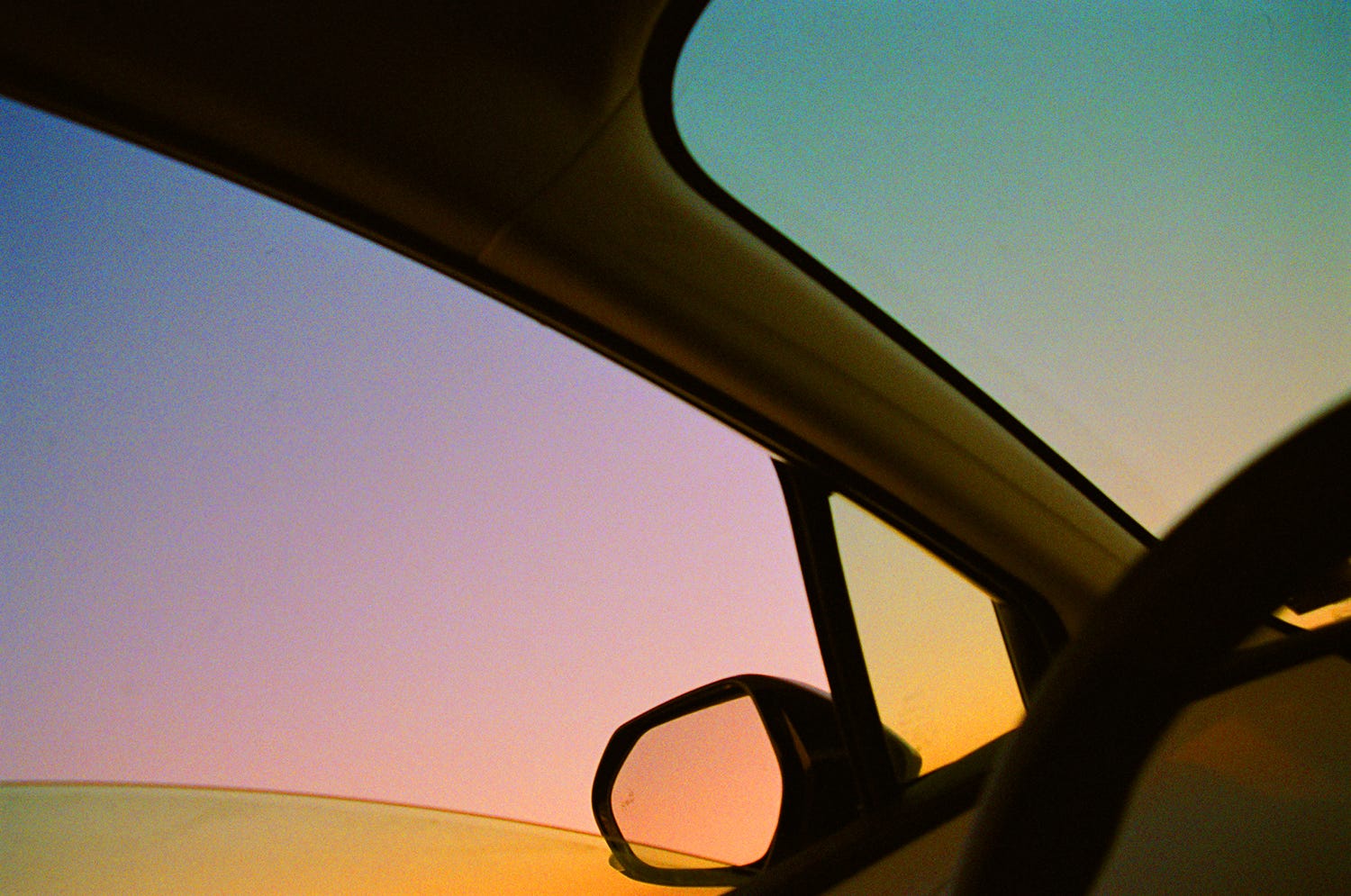
I have a theory that I’ve cribbed from my mother, let’s call it the First Freedom Theory: People develop a lifelong attachment to the place or thing that gave them their first taste of independence.
For my Dad, it was air travel, taking off from Claremont, California to Chicago at 16. For my Mom, it was Maine, a state of many firsts in her life. “I got my license there, my first drink there, my first job there, so I had my own money, and bought everyone Christmas presents with my first paycheck.” It explains Disney adults rather neatly; at relatively tender ages they were given a ride pass and unleashed.
I have two, my first was New York City. A suburban kid visiting the city for the holidays, I was given a $5 bill and told I could go get a slice of pizza. I remember feeling perversely adult, shoulders back, I was my own person. This remains in me, with my love of walking, my preferred therapy. My next taste of freedom, categorical, brain-altering freedom, was when I got my license at 24 and bought a 1982 Volvo station wagon in Marietta, Georgia to drive across the country. I was DIZZY with freedom. A car turned a continent into a possibility.
I still love a road trip. It is a bracketed mission, a beginning, a route, a destination, but within that lives the dendritic opportunity of every side and back road, every pit stop, landmark, diner, motel, and acquaintance along the way holds unknown amounts of adventure. I wanted to write a guide for a trip that’s well-trod. The drive between Los Angeles and Las Vegas is much traversed, iconic, day-sized — if traffic’s on your side you can be between the two cities in five hours. I’d always suspected there was much to explore just off the road, a world between these two large map points.
This guide is organized a little differently than the others. I wanted to give you a skimmable overview of your options, a choose-your-own-adventure essay. There’s some deranged part of me that wishes I could spend a month exploring a five-hour stretch of interstate, and you could — but you could also choose one, a refueling stop between and with that, the journey becomes the destination.
II. LEAVING LOS ANGELES
Obviously, there are many ways out of LA.
It depends on where you’re coming from and when you’re leaving. The GPS default is I-15 North via the Cajon Pass, fastest (save for Friday afternoon and Sunday return) and with the most services. East Angelenos will find themselves reaching I-15 via the 210/215, just a different on ramp to the same beast. If you’re dead set on romance or avoiding traffic or happen to live in the Valley, take Highway 14 to 138 to the I-15. LA to Santa Clarita to Palmdale to Lancaster.
First, you will need snacks. My recommendation is to cherish the abundance and the wide-ranging froufiness of its offerings. Any way you travel will hold plentiful opportunities for Doritos, drip coffee with chemical hazelnut creamer, jerky in flavors that I cannot condone. LA is for Erewhon blueberries, 4th wave coffee, ceremonial matcha with macadamia milk, farmers market persimmons.
My friend George introduced me to a travel case for Maldon sea salt, which we then used for Starbucks egg bites and whole cucumbers which we ate like apples. This reflects my road trip snack philosophy, pretty much my everything philosophy: High-low. A Snickers tastes better with a thermos of Earl Grey and raw cream, a ripe mango with chili salt and lime juice is the perfect accompaniment to a bag of Takis Nitro.
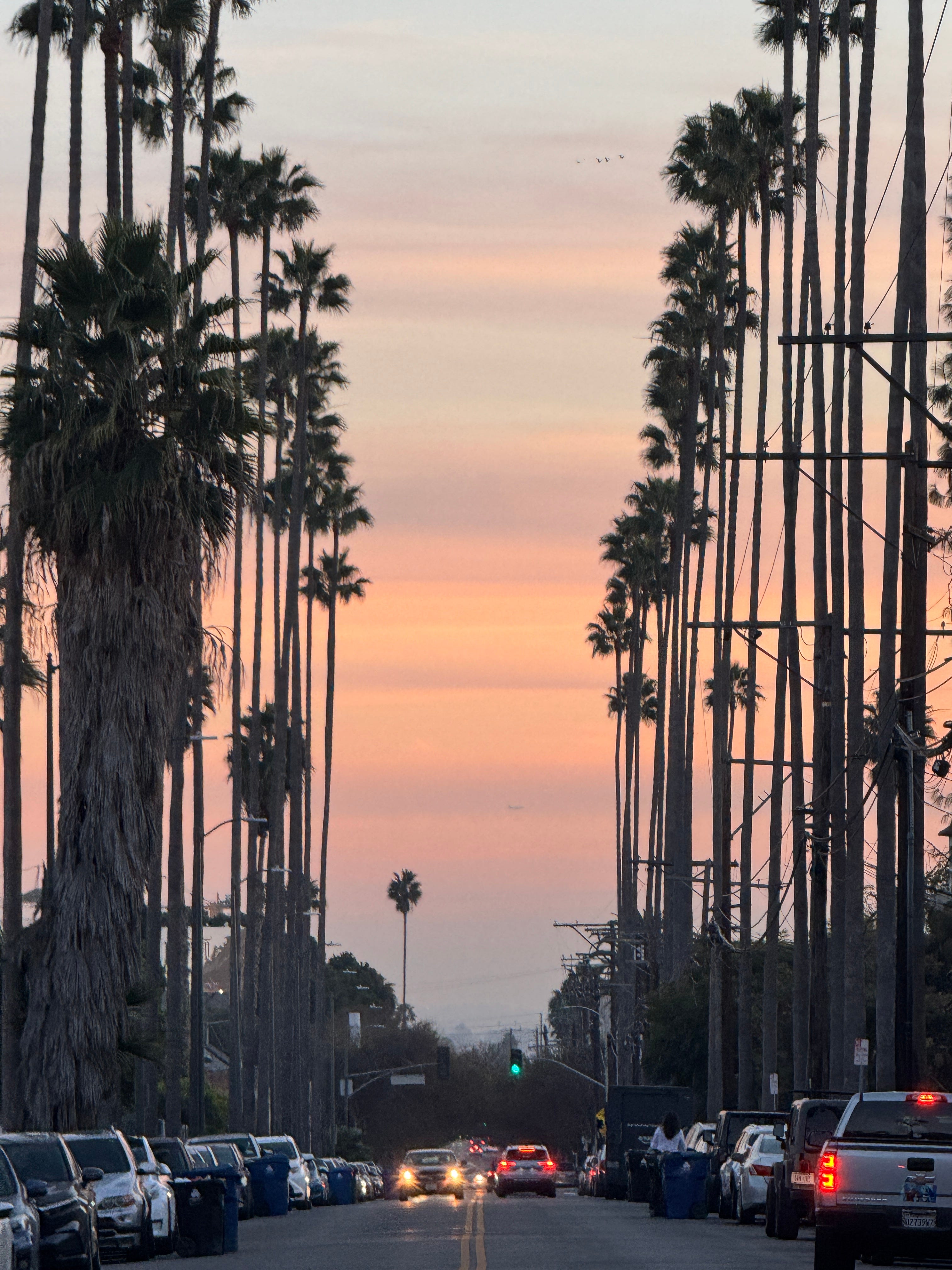
Prepare accordingly, gas doesn’t seem to get much cheaper till Victorville and then spikes up again till Nevada. Wherever you’re coming from, queue up this playlist, take one last urban breath before diving into the high desert.
III. SAN BERNARDINO COUNTY
San Bernardino County is bigger than you might think—if you’ve thought about it at all. It’s the largest county in the lower forty-eight, and my only relationship to it is that it was where COVID vaccines were available when they were sold out throughout Los Angeles. Route 66 cuts through it as Foothill Boulevard, leading to a small quadrant where two of America’s most iconic exports began in the most Californian of ways: fast food. McDonald’s and Taco Bell both trace their origins here—Taco Bell technically begins in Downey, but Glen Bell opened his first restaurant, Bell’s Drive-In, a stone’s throw from the original McDonald’s, across from Mitla Cafe, a family-run Mexican café that legend has it he either stole or borrowed the ground beef, hard-shell taco from.
The Historic McDonalds Museum is on a boulevard shared with a revival arcade, a military museum and a couple of happy junkyard dogs. Outside is a sculpture garden with all the McDonald’s mascots and their town of characters, and I started to clock the bizarre carceral cinematic universe they created for children. Early McDonaldsland created a fully rendered civic order; Mayor McCheese and Officer Big Mac were the cheerful, authoritarian counterpoint to the bedlam perpetrated by the Hamburglar. Inside the restaurants, children’s playlands were modeled as miniature towns and streets, inducting kids into citizens in a world where hamburgers were capital; sacred property to be protected, recovered, revered, endlessly circulated.
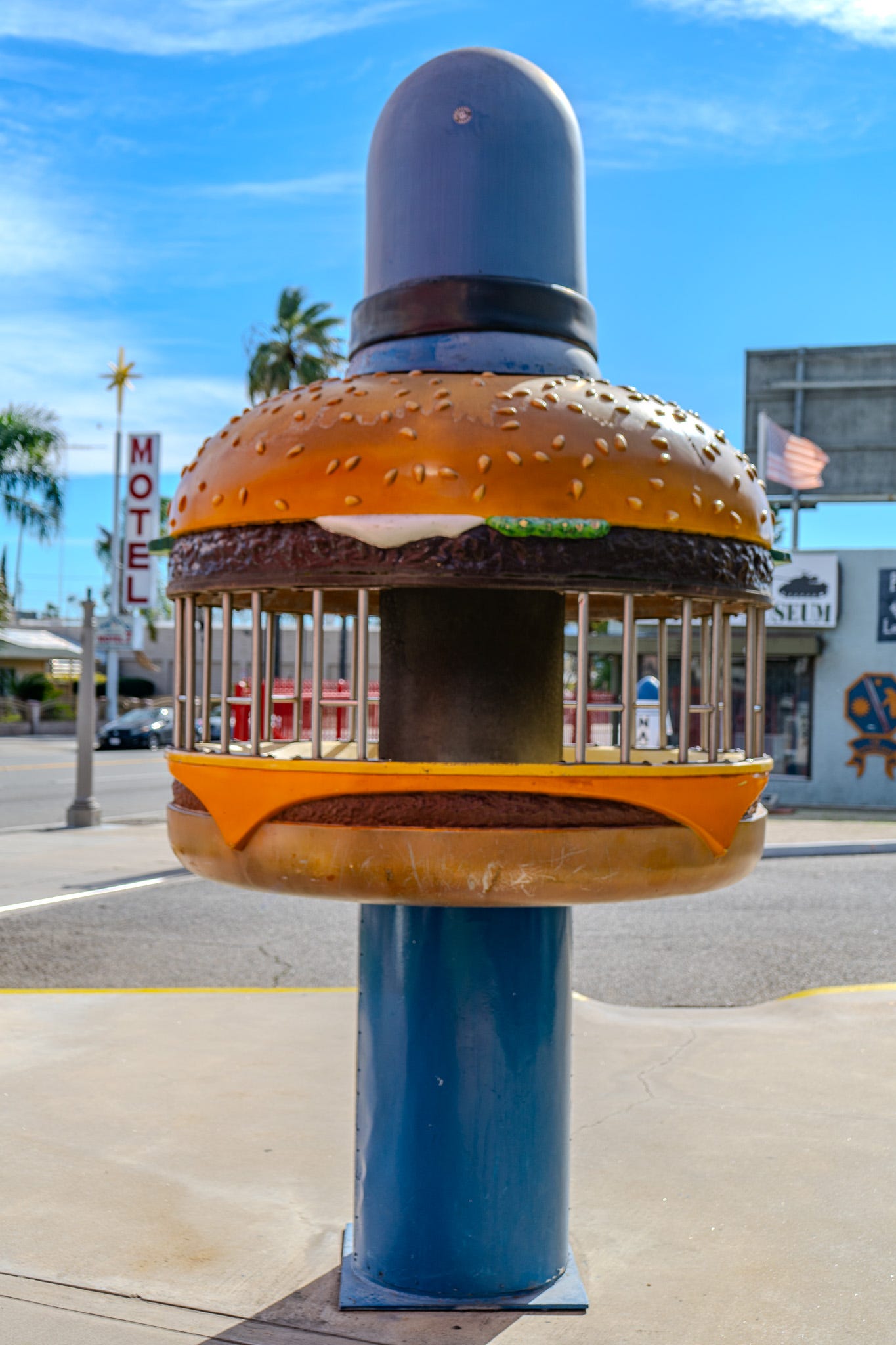
The manager, Marvin told me that during the filming of The Founder he believes his phone and the museum owner’s were tapped by corporate headquarters; that two of the first employees at the original KFC were Dave Thomas and John Wayne Gacy; and that when a McDonald’s closes or relocates, it is officially referred to as being “de-arched,” which my friend later described as “like pulling off a butterfly’s wings.”
IV. VICTORVILLE: THE HIGH DESERT
I stopped because I’d seen a chrome and neon diner with a turquoise awning. In the distance the mountains had snow on them, in the parking lot the palm trees were whipping in the wind. I love California for this and found myself thinking in the whine of the intersection, if it weren’t for all this ugliness, it’d be beautiful.
Richie’s Diner had an impeccable Spanish omelette, and in the future, some hungry afternoon I will experience their homemade deep dish pie option. The waitress knew everybody that walked in, so I felt confident she could point me in the right direction for local treasures. My intel reconnaissance went something (exactly) like this,
“Are you from here?”
“Born and raised.”
“Oh great! What do you recommend I do in the area?”
“Mmmmm, maybe you should go see a movie?”
“Or….you could go to the mall but it just had a shooting so it’s a little sketchy over there.”
Another customer piped in, “I still go…There’s a Burlington Coat Factory.”
Her dining companion said, “Yeah, we’re pretty limited up here, but it’s fine, just for living.”
People are generally bad at knowing what is interesting in their area. It’s too close and they’re not curious about it in the same way. Like they said, “it’s for living.”
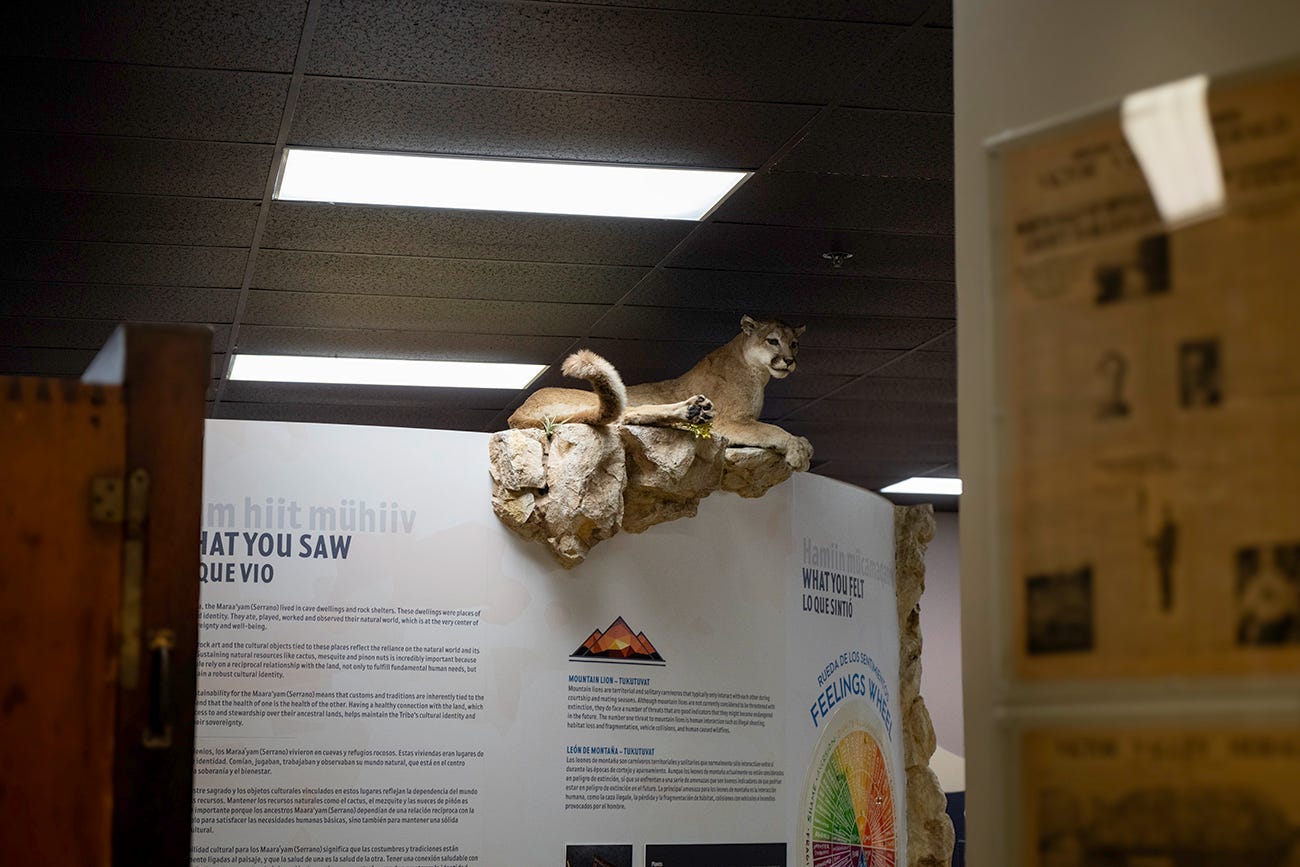
In the Victor Valley Museum, I realized the trouble with blowing in and trying to understand this place—it’s secretive and subterranean, a place of borax and sulfur mines, seeps and springs, wind channels that whistle between the lavender shadow of mountains, coyotes and gypsum, finches and road runners. There’s a foam-core-fake cave with coyote skulls and rams horns and rattlesnake skin to touch, and then when you get out there’s a feeling wheel so you can know how you feel about the cave. I realized I felt optimistic and insecure, after learning that Dorothy Parker had lived in Victorville for a year, and hated it.
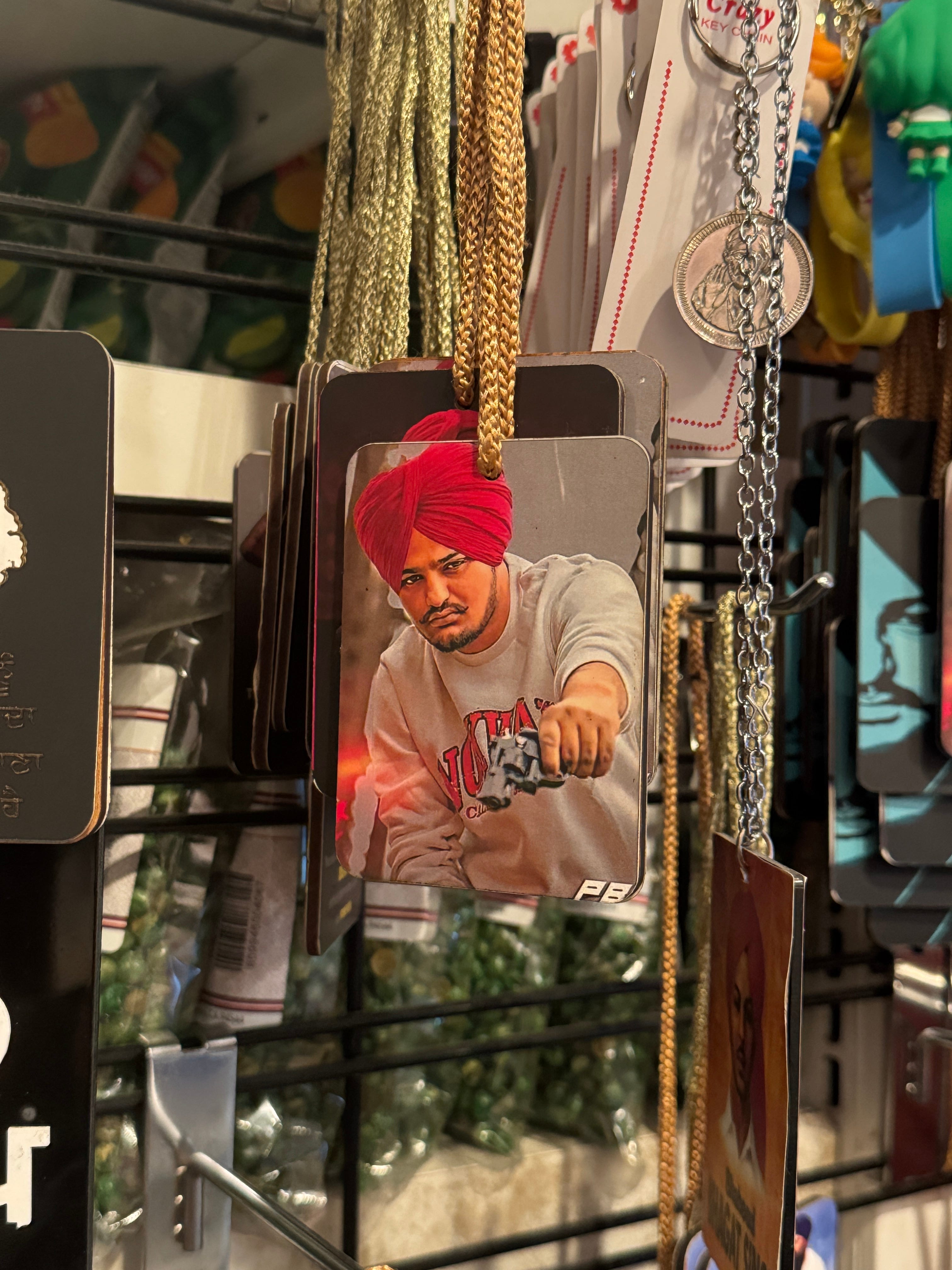
I did end up finding a gem though: Flavors of India – a 24-hour Punjabi restaurant in a truck stop. There were huge hangars where men were hosing down their RV’s and big-rigs, and in the back where I parked there were road runners and stray cats eating biryani like birdseed in the wind. Inside, there’s a primarily vegetarian menu and hot chai, along with an Indian grocery store and a sneaker shop. You can buy: traditional indian brooms, rose petal spread, Golden Temple magnets, Magic Marsala Lays potato chips, Mysore sandalwood soap, Sidhu Moose Wala merchandise, jaggery candy, a wide array of lidocaine products for the truck drivers.
They should put the feelings wheel at all exits, everywhere.
V. BARSTOW
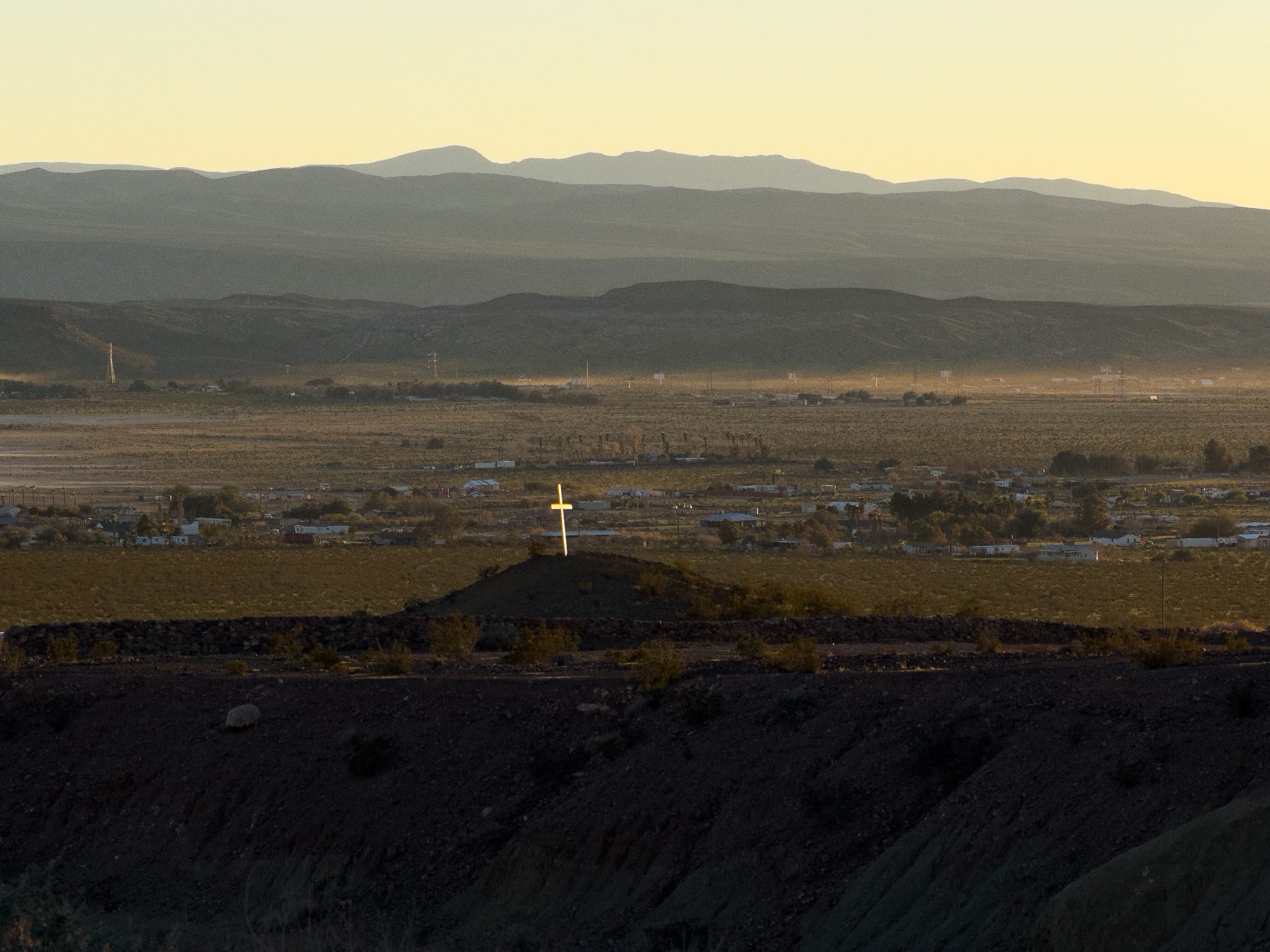
Barstow was when I remembered the importance of having and carrying pet food. The high desert is notorious not only for their overcrowded shelters but also for the amount of dumped and stray animals. It’s important to have something to feed them at the very least, and if possible lure them into your car and keep them forever and get them spayed and neutered and teach them how sweet life can be — that is my wish for the desert animals.
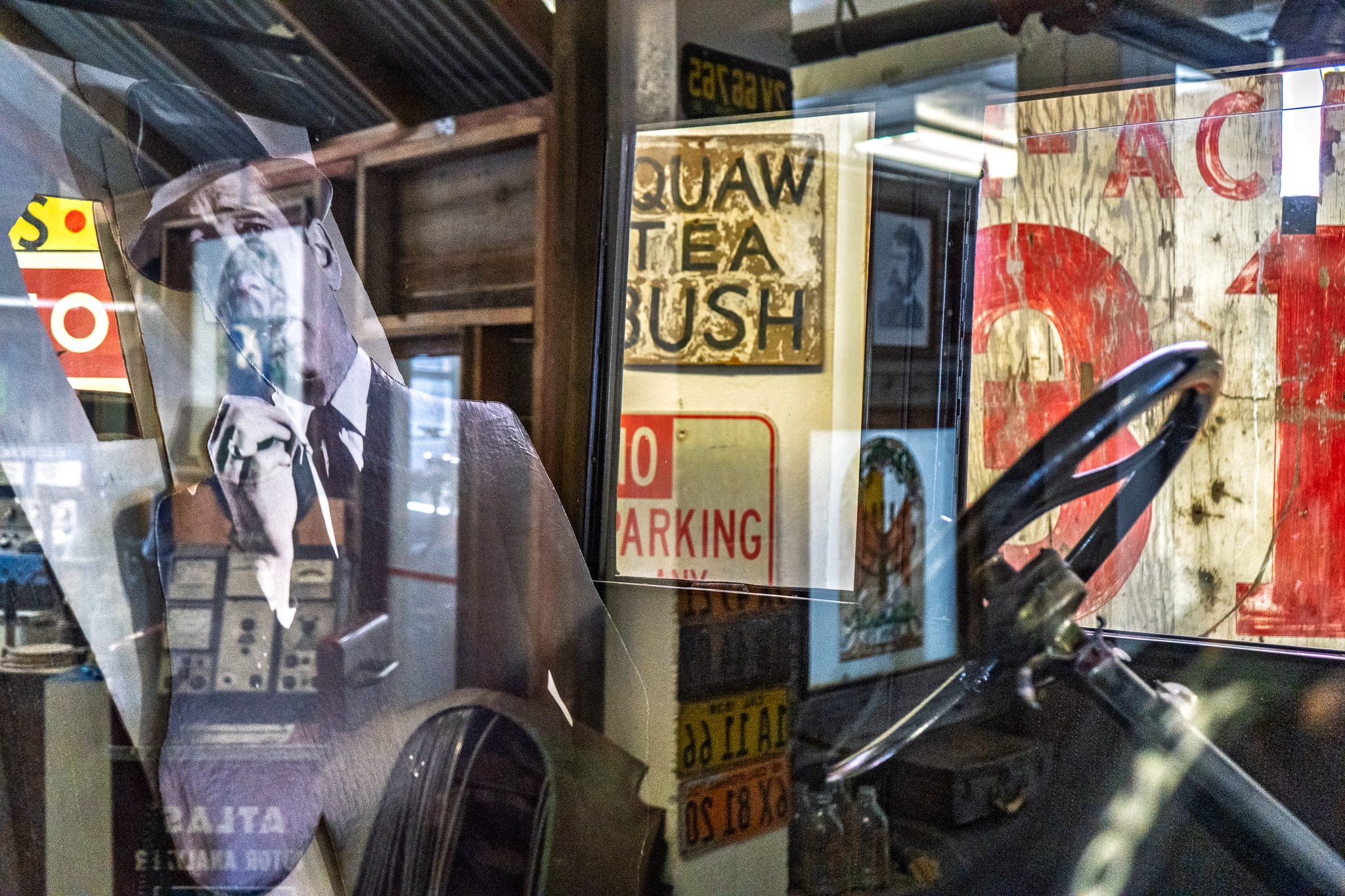
All the Route 66 stuff is really sad, it’s so stuck. Like, now there’s Merritt and O’Keefe stoves in the Route 66 museums, Made in China keychains and bowling shirts and mugs, a cut out of Humphrey Bogart sitting in a Model-T. There’s clearly a time when it stopped and has never come back. This was the first time that a local said to me that if I really wanted to understand the area I needed to watch the Pixar movie, Cars. I did, later, and what a GEM.
Main Street has a lot of murals, and that’s when I realized that this trip I’m on has deep, mutlti-faceted lineage. This is a trail, it always has been. It was an indigenous footpath, it was the Old Spanish trail, it was the Mormon trail, it carried the Gold Rush era prospectors, stagecoach and wagon traffic, the Atchison, Santa Fe, and Topeka Railways, was surveyed by the U.S. Army Corps of Engineers paving the way for the area’s military and aerospace presence, then Route 66 and eventually I-15. It’s a desire path.
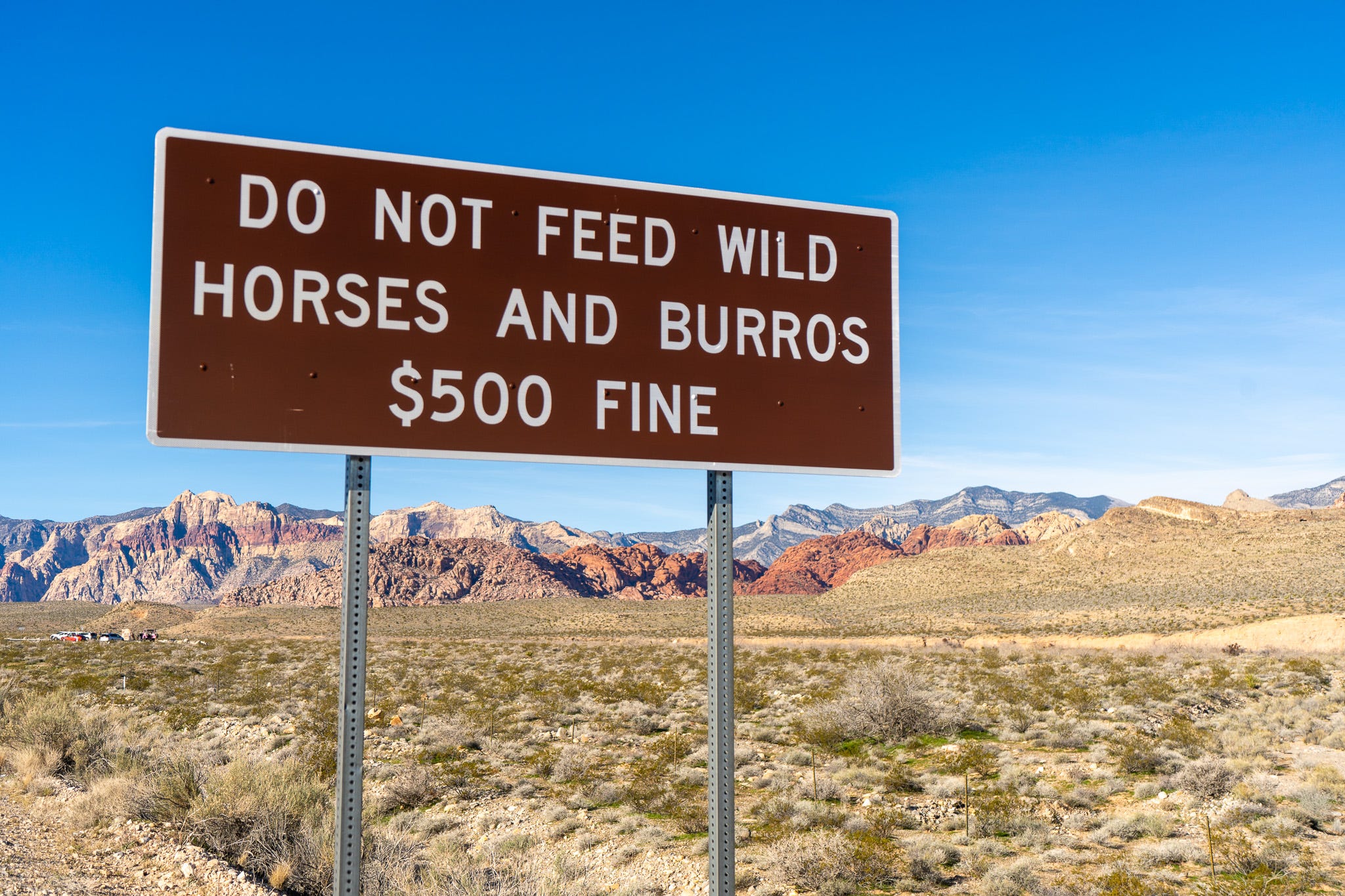
A thing I think about a lot in desert exploration are those signs that tell you what animals live in whatever completely arid expanse you are currently at some roadside lookout of; they tell you there’s gopher snakes and bobcats, tarantulas, cotton tail rabbits, kangaroo rats, side blotched lizards and horned toads, big horn sheep and desert tortoises, but I see nothing and no one, and it’s hard to believe that all that something is to be found in what appears to be profound and hostile nothing.
A. Goldstone Deep Space Complex
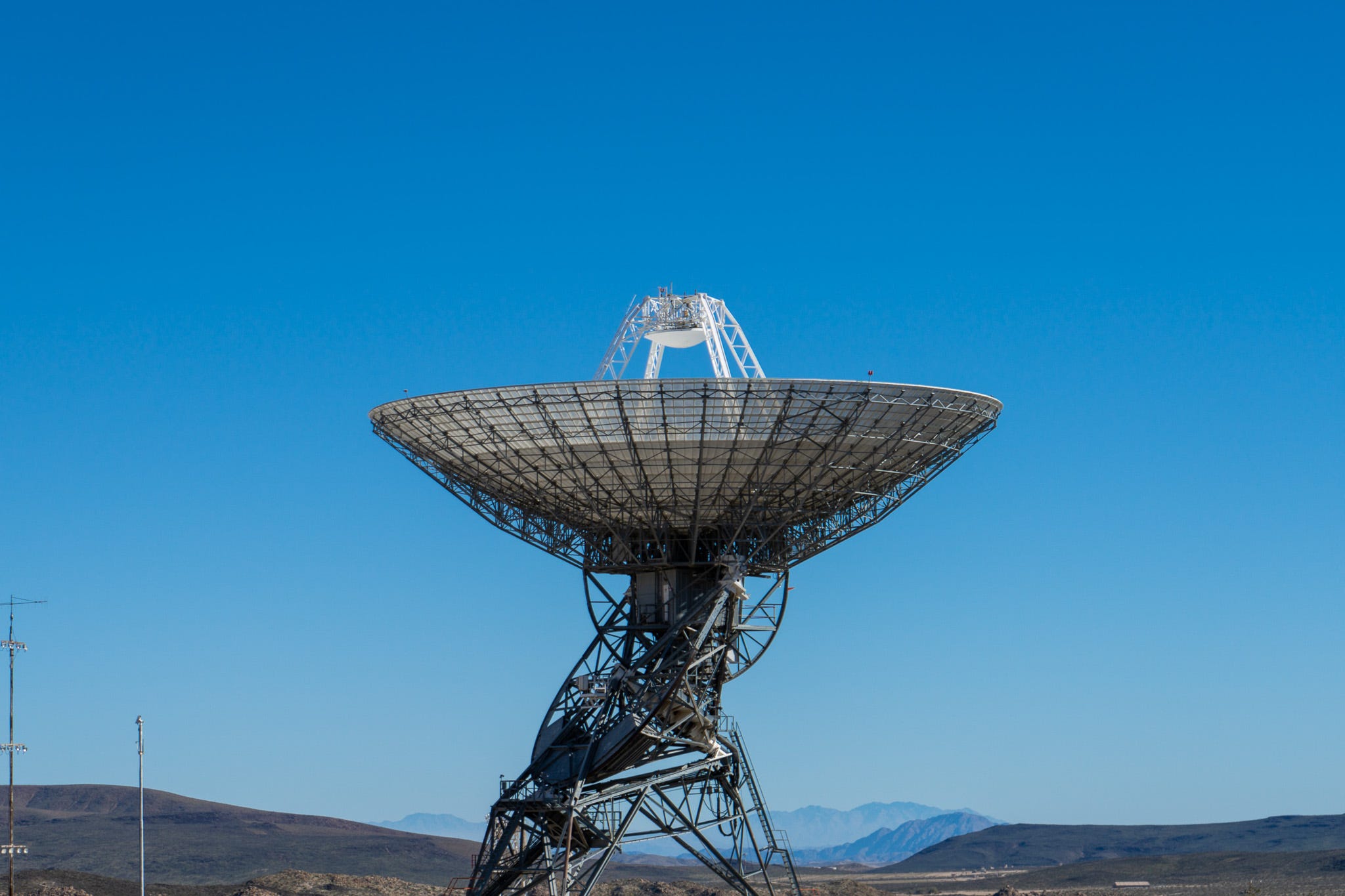
I wanted to see the Goldstone Deep Space Complex satellites. They’re located within the NASA complex on Fort Irwin, an active military base. I called, left messages. I emailed multiple times. When I visited the Harvey House in Barstow, there was no information about how to actually take the tour that seems, according to Google Maps reviews, to exist. There are enough selfies of people standing in front of the satellites that I assumed, wrongly, that this was something I could do too.
So I did what my experience as a location scout has taught me: Showing up is often more effective than a hundred unanswered emails. It’s a far more dignified “SPEAK TO A REPRESENTATIVE” move *imagine me yelling into the phones mic*.
At the Fort Irwin reception desk, I explained the situation. The man on duty tried calling NASA with me — three times. Eventually, I think he was as annoyed as I was, because he issued my friend George and me day passes and told us to go “check out what’s going on, and tell them to answer their phones.”
We drove about six miles past the entrance and reached a guard hut with an open gate, a stop sign, and no guard. We waited. After a few minutes, we debated getting out, but decided it was best to stay in the car until we spoke to someone. We reached another gate. It opened automatically.
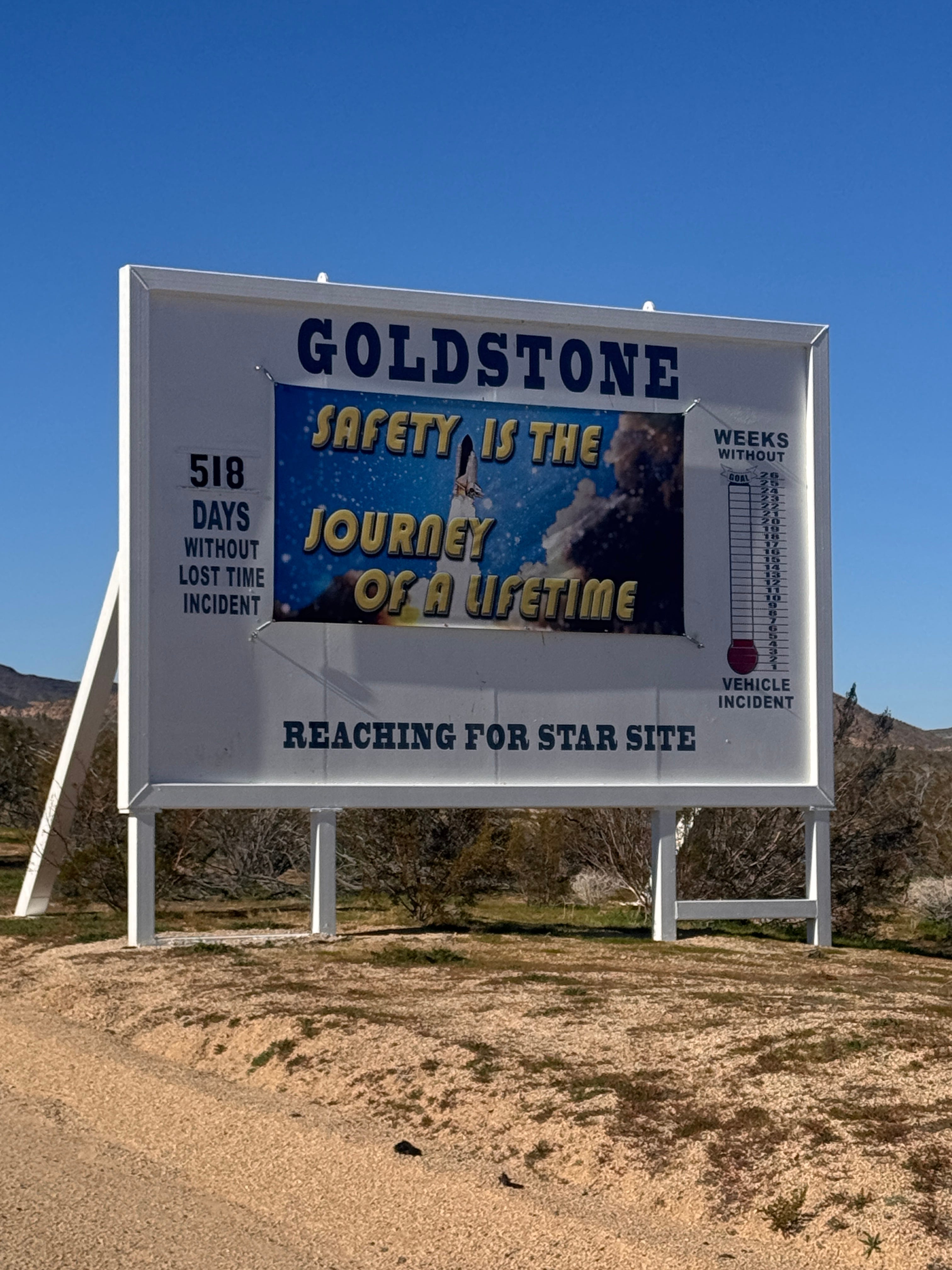
We parked, went inside, and eventually found a woman who explained that the person who normally handled tours was out on medical leave. She gave us the extension for her replacement and returned to her paperwork. We stepped back outside, I doubled back to use the bathroom, and when I came out, two military police cars were speeding toward George.
I was confident I could explain everything: the calls, the emails, the day passes. Instead, we were held for four hours, telling and retelling our exact movements to a rotating procession of stern and disappointed men. We were asked why we didn’t stop at the stop sign, so we told them we did, and they told us we should’ve waited at the stop sign for 10 minutes and then gone. I thought about explaining that that’s not how stop signs work for civilians but thought that might not go well. Eventually, we were issued a citation for trespassing on a military installation, barred from the base, and given conflicting information about how to appeal. As of publication, I believe I have about six weeks before I learn my court date in Riverside.
Suffice it to say: I do not recommend my methods. The truth is, I saw the satellites from the road. They’re big and fine. You can see everything you need to see online.
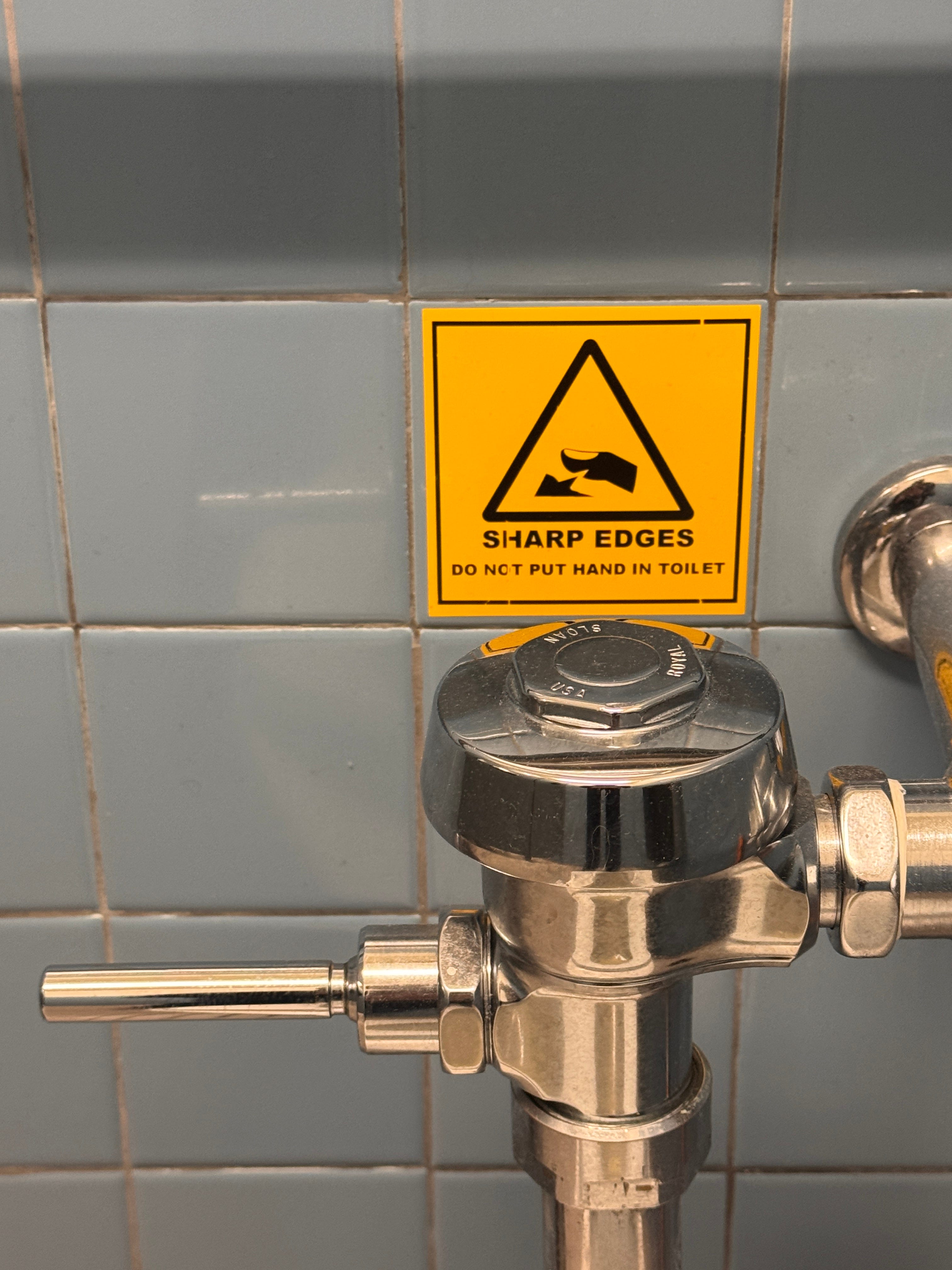
The only thing that felt truly worth the trouble was a sign in the NASA bathroom — the only bathroom where I’ve ever seen this — warning me “not to stick my hand in the toilet : sharp edges” Heard. From now on, I will heed all NASA signage with a wide conceptual berth.
B. Skyline Drive-In
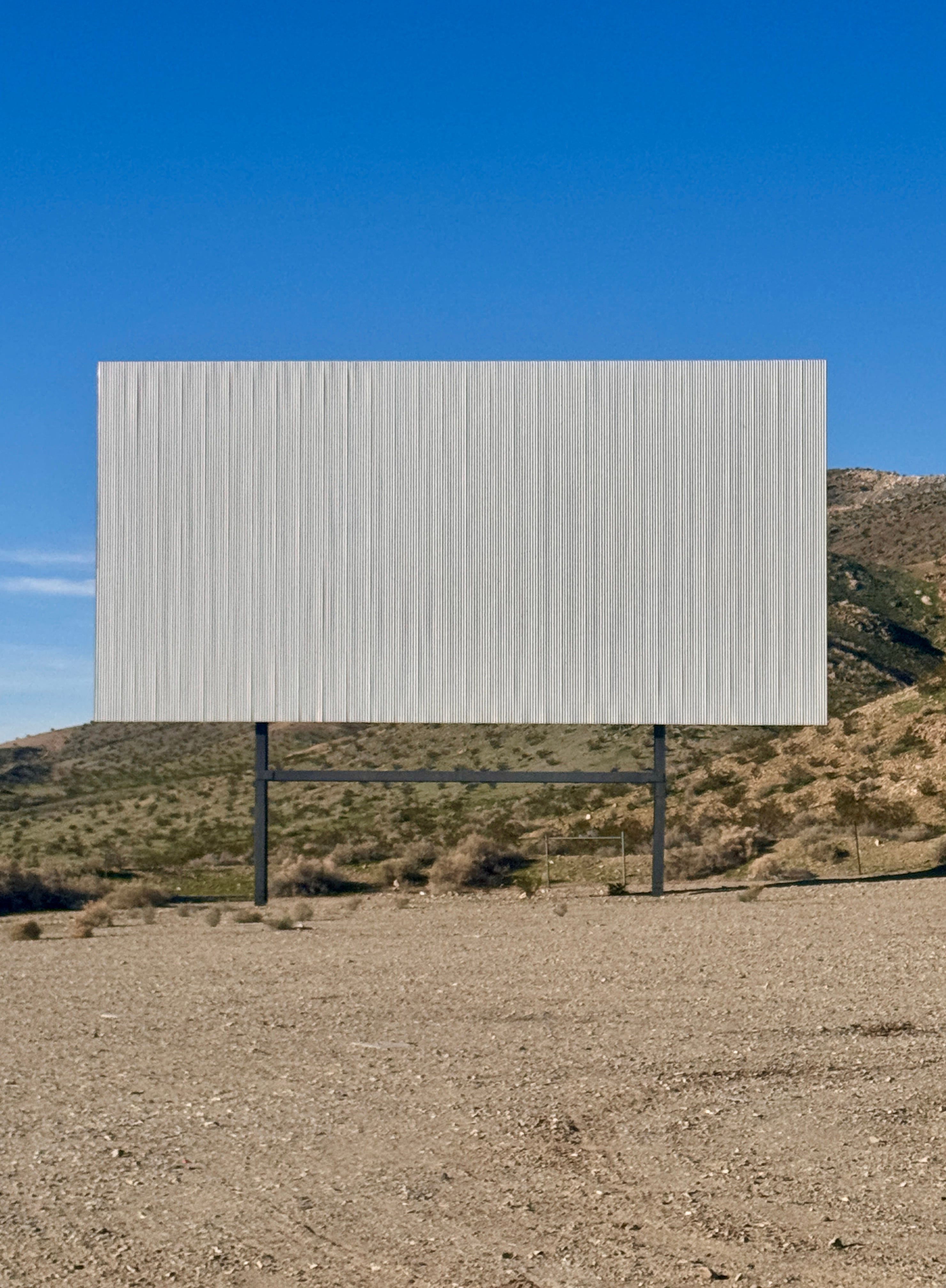
Skyline Drive-In is run by Martin Smith, whom I met fixing a tractor, then repainting a salvaged marquee, then later playing Galaga on one of the two massive screens; a man of many projects. Off-season, the place becomes less drive-in and more of a hangout headquarters. During programming, it skews family-friendly box-office normcore (check their Facebook), and now my dream is to return on one of the warmer summer nights to see The Odyssey projected onto what Martin called “the dark screen,” the smaller one facing the mountains, instead of the big one haloed by the small glitter of Barstow below. Downhill: a Mad Max–ish boneyard of salvaged cars and bikes. Smith and his father also own the Sunset Drive-In in San Luis Obispo and fly or drive between the two; he says the best place to watch SpaceX launches is the roof of the concession stand. In retrospect, I wish I’d just brought a deck chair and watched the fat comet tail of a launch, and called my space thirst quenched instead of trying to tour a military installation.
C. Bottle Tree Ranch
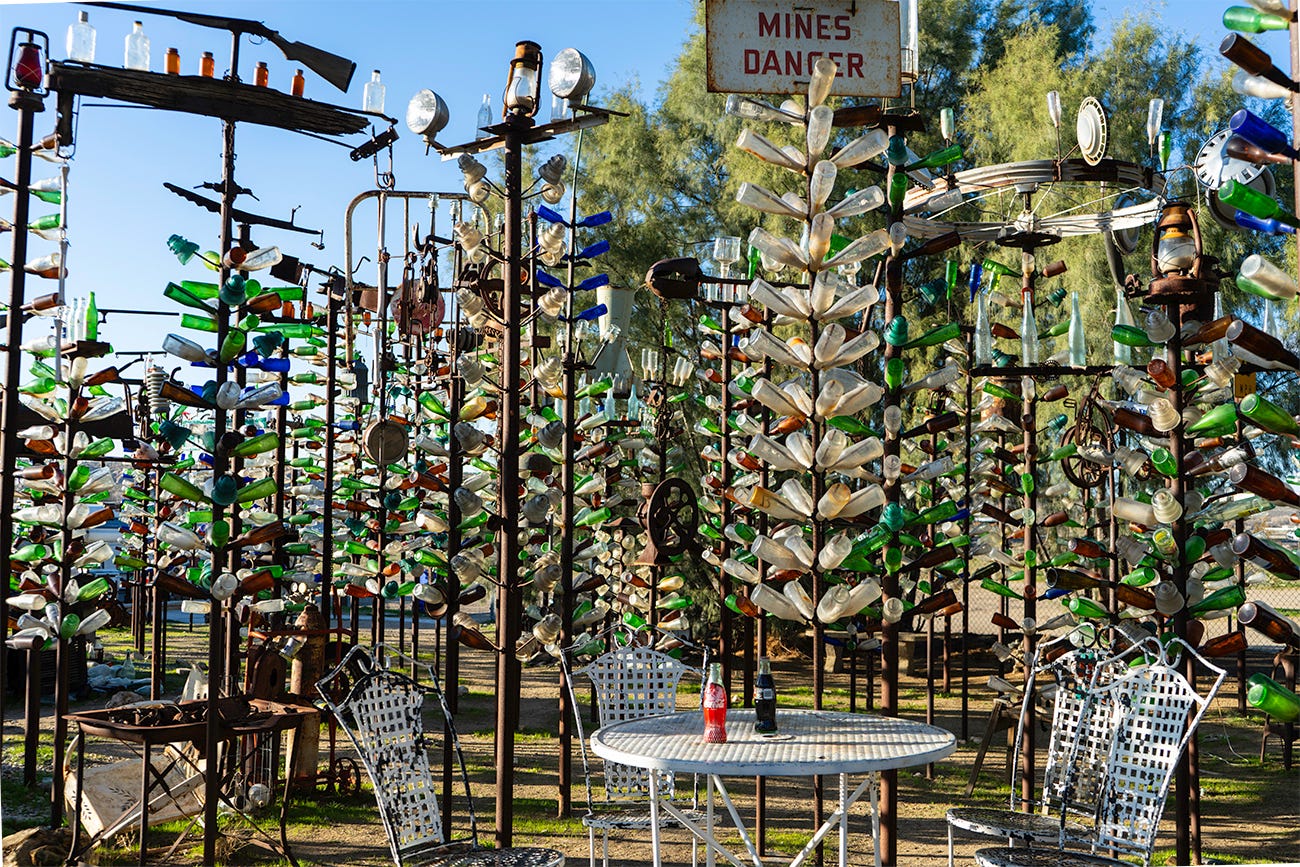
Bottle Tree Ranch is for the people that pull over. The trueblue, deepstate weirdos. I could argue that all artists are outsider artists – or that the best ones are – and you’d be free to disagree. But if you’re drawn to projects completed out of pure compulsion, or idiosyncratic makers fulfilling their own private prophecy, Bottle Tree Ranch belongs in the same category as Leonard Knight of Salvation Mountain or Simon Rodia of Watts Towers.
The name is mostly self-explanatory, but for clarity: A football-field-length stretch of land is staked with poles acting as tree trunks, their arms sprouting salvaged bottles. The day I visited was windy, and the “trees” shook, chattering the bottles like teeth — a sound somewhere between wind chimes and warning, delight and horror. Each tree is crowned with another piece of salvage: a rocking horse, a rifle, a hubcap, a lantern, a stoplight, a chandelier, a birdcage — sometimes just a rusted wrench placed just so.
It’s free, right off Route 66. There’s a donation barrel with a few quarters rusting at the bottom. There should be far more.
VI. Yermo
A. Calico Ghost Town
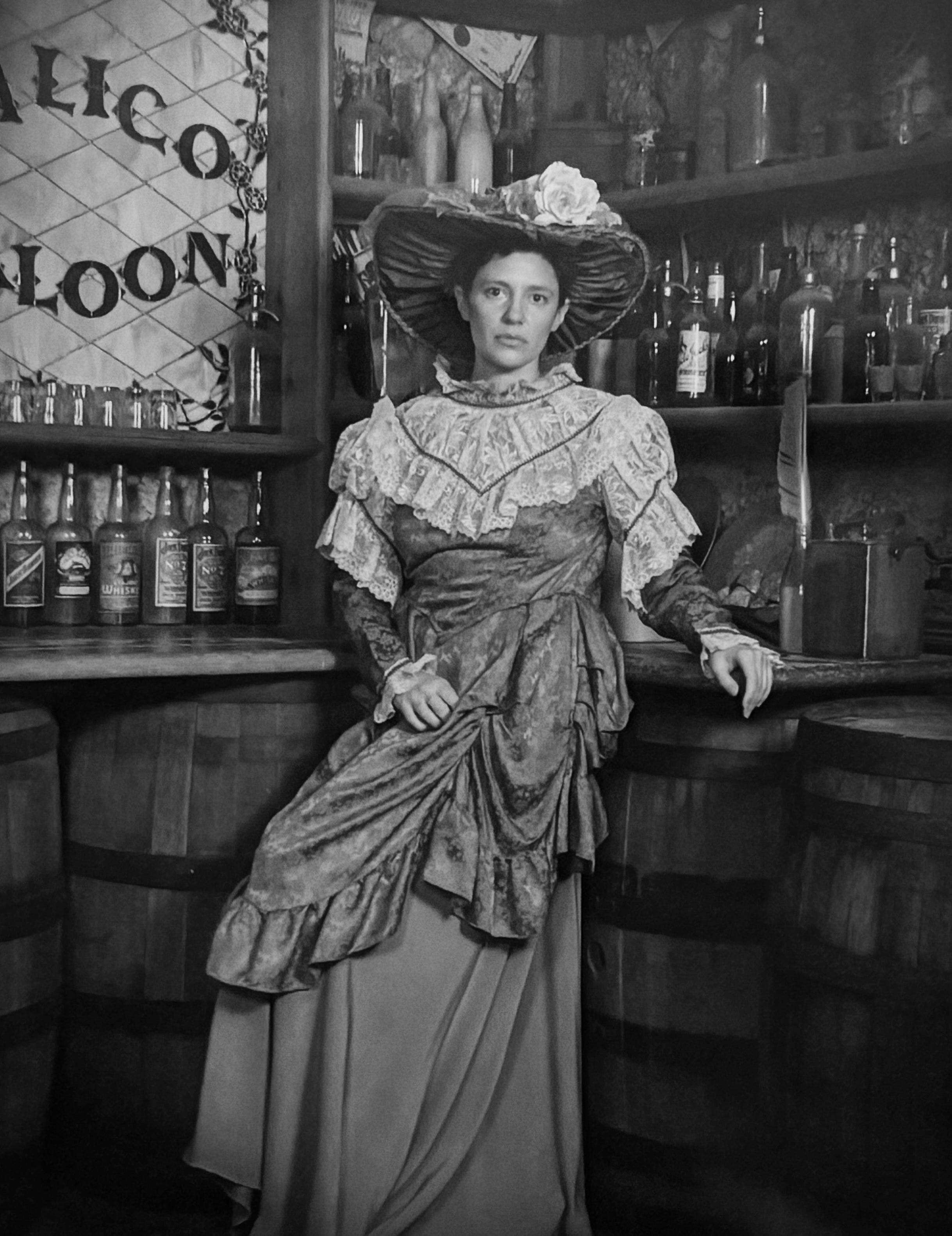
When Walter Knott and his wife Cordelia Knott were still pre–Knott’s Berry Farm fame, they were homesteading in the Mojave Desert. When that proved to be as inhospitable as you might imagine, they moved to lusher farmland in Buena Park, where Knott popularized the newly invented boysenberry.
Cordelia ran a tea room serving fried chicken, and the wait regularly stretched for hours. Knott, an American genius of recreational appetite, decided the customers needed something to do while they waited. He began building roadside attractions and exhibits, eventually developing a Western-themed ghost town on the property. Over time, he acquired several real ghost towns across the Southwest, including Calico Ghost Town, a defunct silver mining town that collapsed after silver lost its value in the late 1800s.
Knott was a booster for California Republicans (notably Nixon and Reagan) and his fortune-making during the Great Depression bred that very particular, problematic kind of American dream logic: plucky, bootstrappy, with a real hard-on for the Old West. It’s a strange thing to glamorize a mine.
I went for the views, for the placeness of it all. Calico feels closer to a national park than a theme park. From the hills, you can see all of Barstow and Baker and watch the desert change color as the park closes: orange, then pink, then gunpowder blue.
I had my portrait taken as a Victorian saloon madame, slipping into a polyester dress worn like an apron or a bib and a high-wire act of millinery. I was told to channel “young Angela Lansbury,” which felt hold-my-beer-right, given that I’d just seen her as the brassy, bawdy counterpoint to Judy Garland in The Harvey Girls, set at the Casa del Desierto, Barstow’s historic Harvey House, the culinary crown jewel of the western Railway. I knew exactly what to do. It helped that I had an incidental bloody eye to toughen the look.
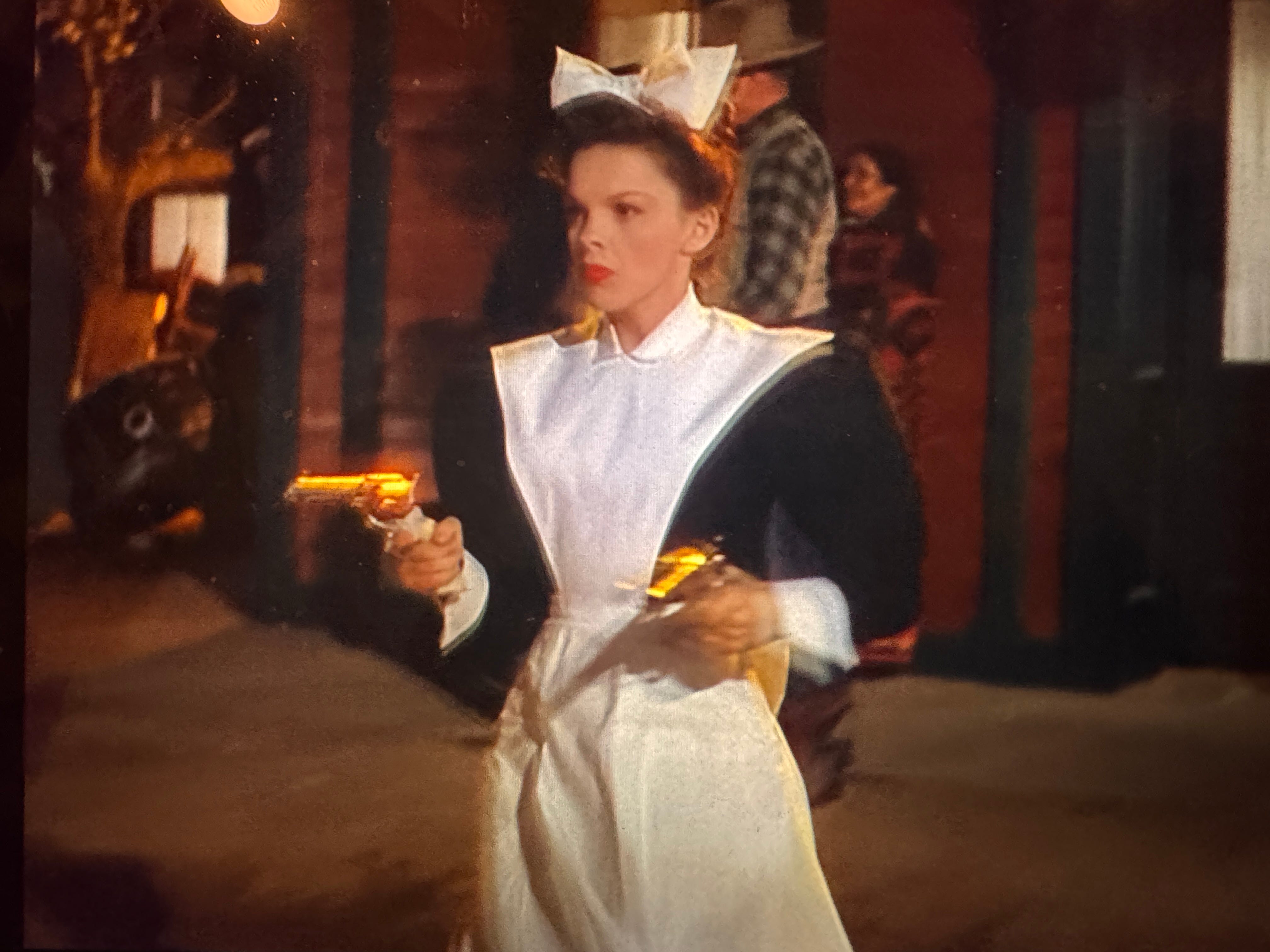
B. Dolores Lake
I did not make it, because I was detained by military police at NASA, and perhaps that’s for the best, it was plenty of adventure for one day. It was once a very popular, extremely dangerous water park that had so many injuries they had to move an ambulance dispatch closer and then eventually close it. “The various ways to get wet are half the fun.”
C. EddieWorld

Bucc-ee’s, Terribles, EddieWorld – the pantheon of mega-reststops – each promising halls of pristine bathrooms and enough random razzle dazzle that kids can log it as an event, your tired driving eyes can unglaze, and you can stretch your legs by walking the aisles through a frenzied taxonomy of All Things Snack.
Know that EddieWorld is exploitatively expensive and get over it — the Strip starts here. Here, snacks are weighed like Parmesan Reggiano or gold: a bag of dark chocolate peanut butter cups might run you $8, a quarter-pound of lemon-pepper beef jerky closer to $30. You can also purchase a life-size King penguin, a plush vulture the size of a miniature pony, pickle taffy, coconut curry worms, or “missing body parts” gummies. Don’t miss the “flavored nuts” section.
When Bugsy Siegel looked out at a stretch of desert and imagined acres of all-you-can-eat king crab, some part of his heart also wanted a guaranteed fresh sushi bar at EddieWorld in Yermo. Consider it your pre-Vegas hyper consumption warmup.
D. Liberty Sculpture Park
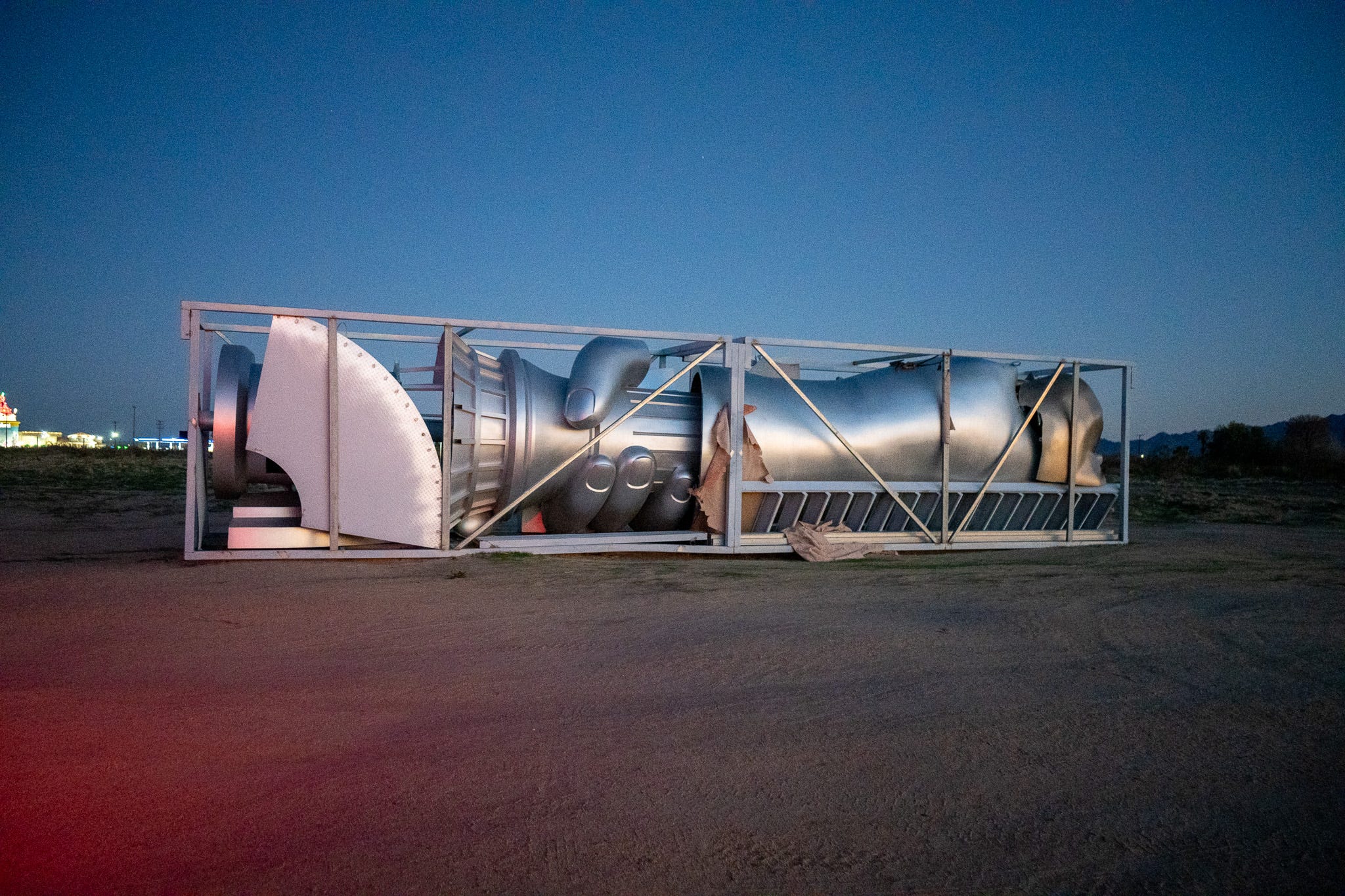
The desert is generous in that it gives people the room to build exactly what they mean. If the sign at the entrance “Communists Not Allowed” is in any indication – this is no municipal park. This cheeky, little democratic socialist proceeded.
The entrance road is lined with revolutionary figures: Zelensky, Tank Man, Lakota Chief Crazy Horse, Lu Xiaobo. The large 64 you can see from the interstate is a reference to the date of the Tiananmen square massacre. This is a screed, a scream, a political installation at the gates of the Mojave.
The set and setting predispose you to thinking that this is a slightly batty endeavor — something between Bottletree Ranch, a Trump as Rambo mural and one of those 20 foot Jack Skellington statues from Home Depot, but desert-brained. You can see the three-story ice cream sundae lighthouse of EddieWorld glowing in the distance.
I was piqued to learn that the large zombie-skull statue — a face with Coolio-inspired knots — represents the “CCP Virus,” a sculpture meant to mock and indict the Chinese government for releasing COVID-19 on the world. Conspiracy webs aside, it is intriguing to learn that the original sculpture was destroyed by Chinese arsonists and Weiwing Chen, the owner and sculptor, had to rebuild.
E. Peggy Sue’s 50’s Diner
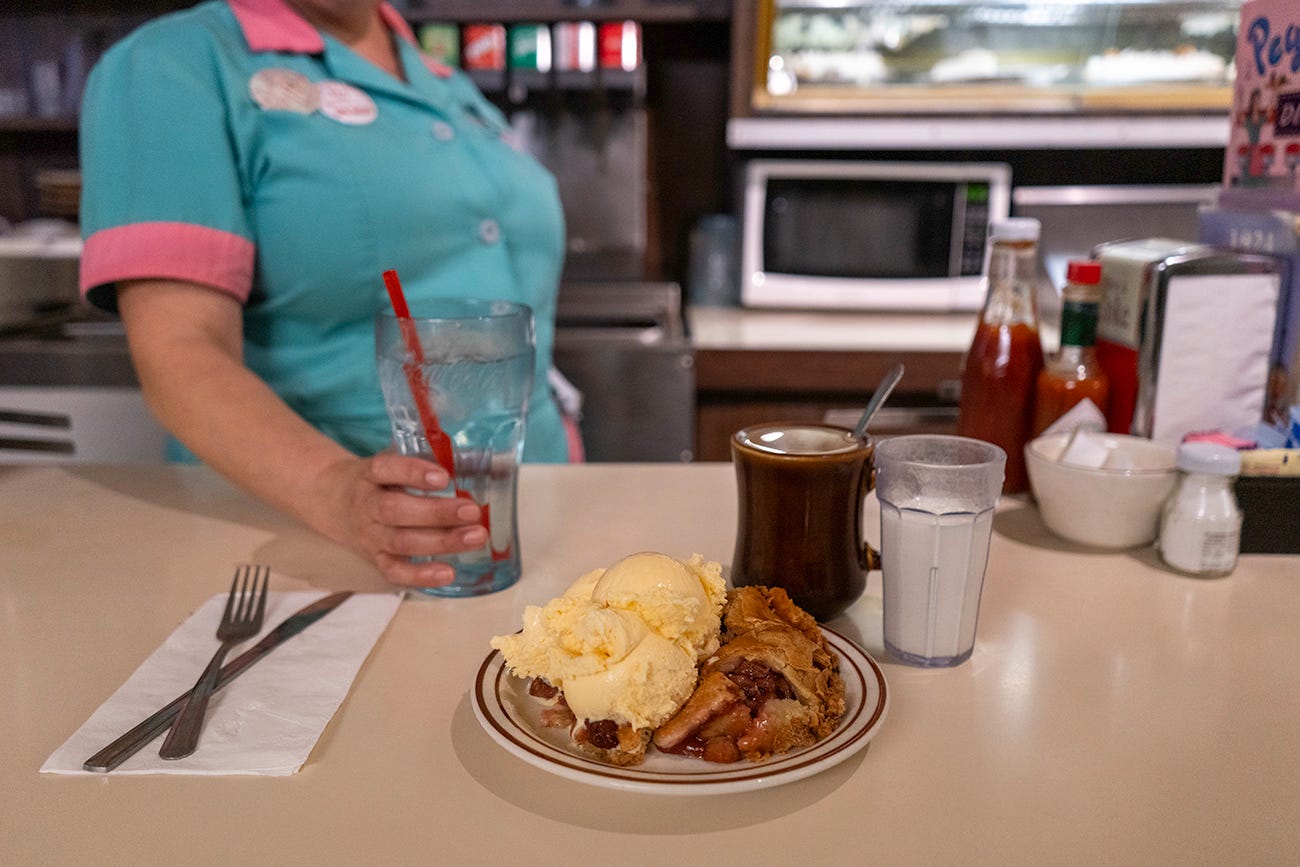
She hardly needs any introduction; you’ll start seeing the billboards a good hour or so before it’s even time to think about an exit. Peggy Sue’s is the 50’s kitsch of your mind’s eye. The front doors are shaped like a jukebox and once inside the choice is: left to the gift shop (which also has a Rite-Aid style ice cream counter), or right to the diner, continue through the diner to a pizza shop, and then out to the back for diner-saur park, a strange garden with rusty dinosaur (and king kong) figures presiding over fountains, wishing wells, turtle ponds, picnic benches. The whole compound is connected through a yellow brick road.
Get the rhubarb and strawberry pie hot with ice cream.
VII. Baker
A. Alien Fresh Jerky
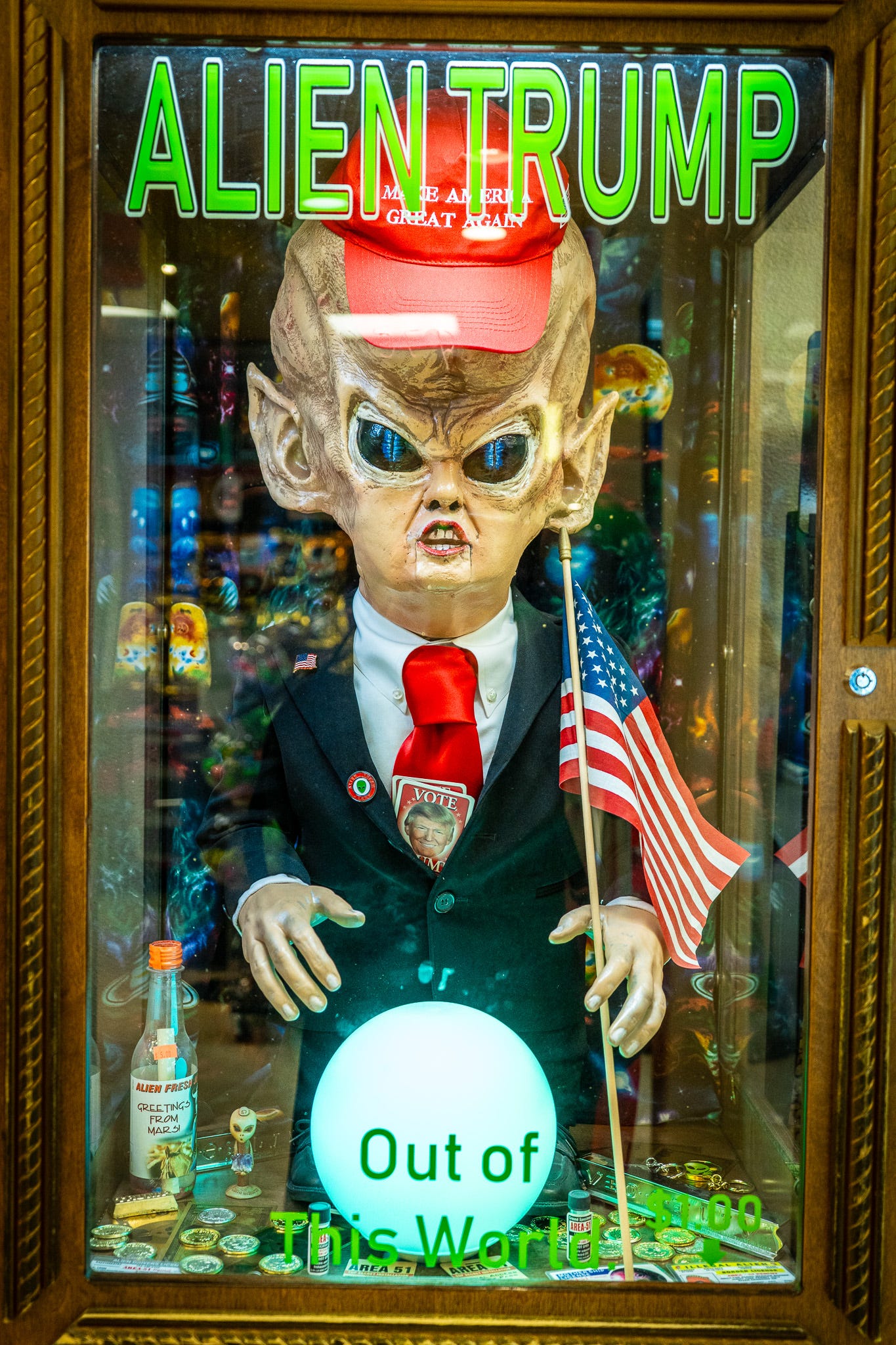
A spaceship as the store. A car with an alien driving it, ALIEN license plate, parked permanently out front. A reviewer calls it “the coolest pit stop in the galaxy.”
Inside: Alien themed beef jerky: Abducted Cow Pineapple Teriyaki, Roadkill Original, Barbecue on the Moon. Little green men scrubdaddy sponges. Alien hats, alien baby onesies, alien tshirts, alien yetis, alien keychains and bottleopeners. A UFO, UAP, and alien-themed books, media and DVD section in the back.
Near the front is a Zoltar-style fortune-telling machine produced in 2020, featuring an alien Trump, which menacingly cycles through a proclamation—he’ll be back, for Biden, in 2024.
B. The World’s Tallest Thermometer
It’s hot out there, babies. The Mojave desert holds the record for the highest recorded temperature on earth, at 137º F which is where the thermometer stops. While it was slightly under 60º when I stopped, it reminded me to buy a jug of water, just in case.
C. ZZYZX Road
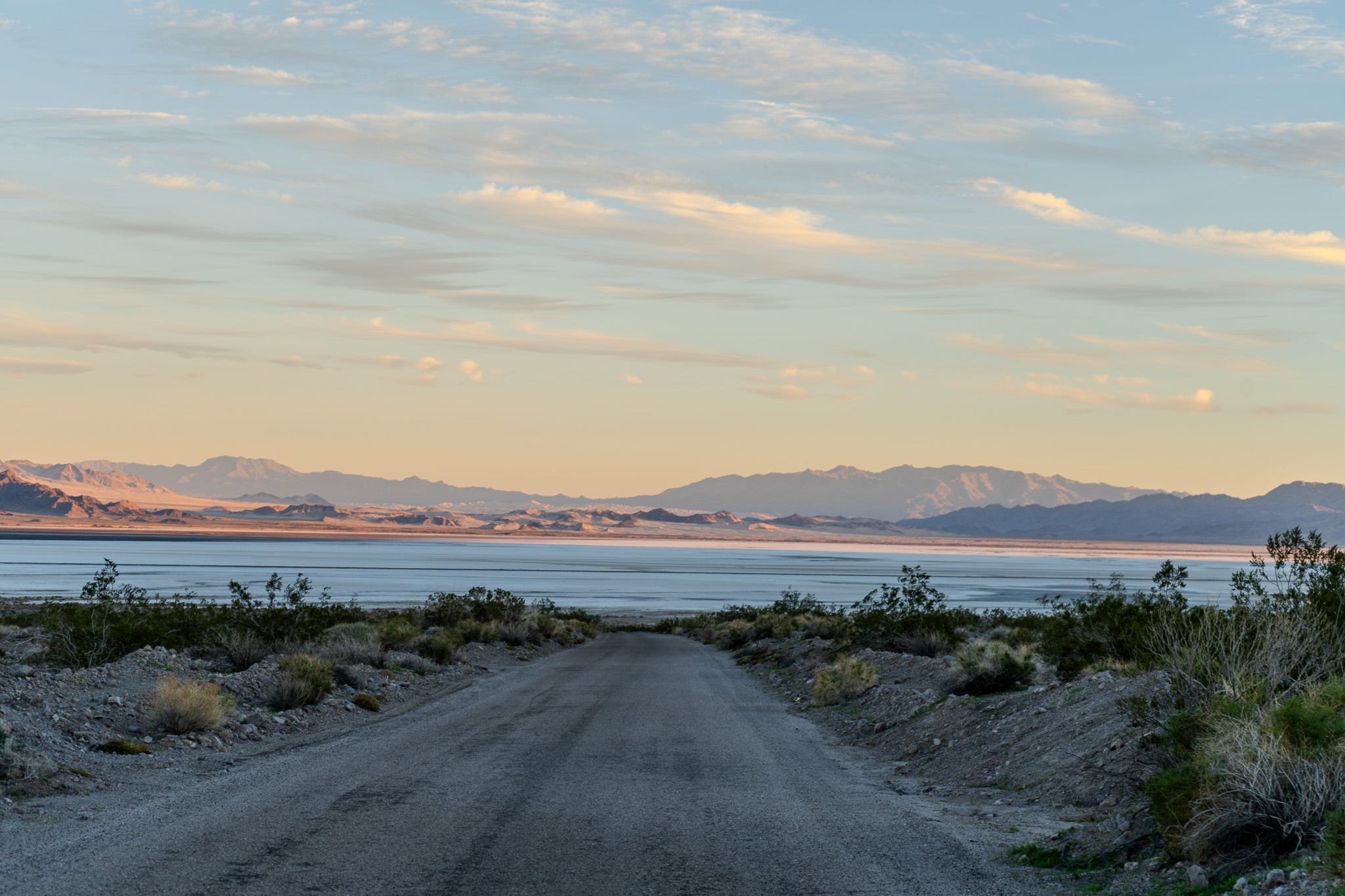
Everyone sees the sign. Pronounced Zee-Zix, Zizz-Ix, or Zizz-Zix. Its strange name, coined by its inventor in the hope of securing the last word in the English language, acts as a kind of mile marker on the drive, the way Pudding Street functions for me between New York and Hudson.
Take the exit, I beg you.
It’s one of the most Martian and beautiful roads I’ve ever been on. And from the moment you leave the highway, you’ll think you see water. It isn’t. It’s a dry lake bed, an expanse of sand so flat and white it reflects the sky. You’re in the valley of mountains that used to be under the sea. You’re on the shore of an ocean that isn’t.
VIII. MOJAVE
A. Bird House
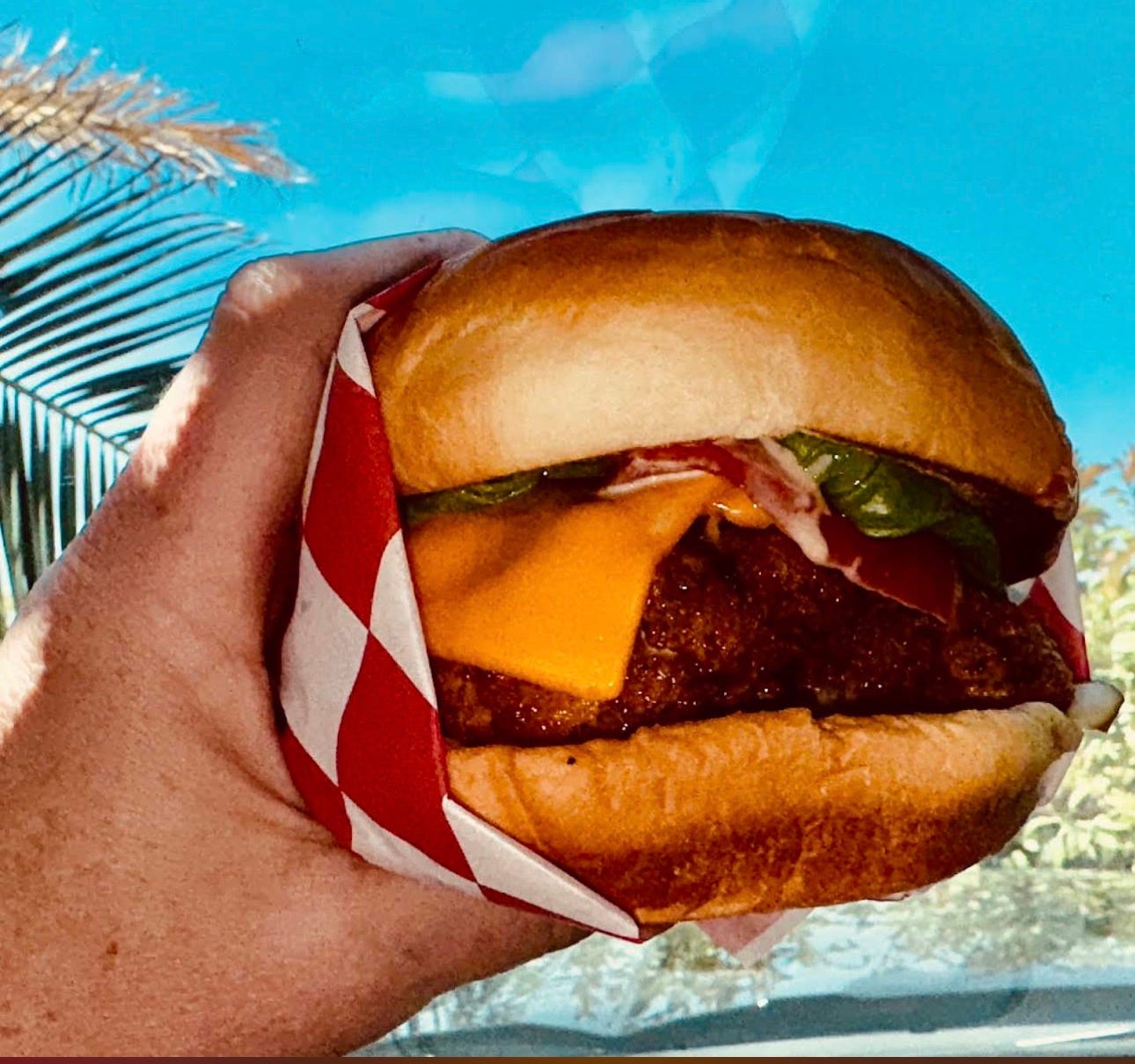
Imagine a decommissioned Pizza Hut in the middle of exquisite nowhere, two bathrooms total make it about 15 stalls shy of a proper rest stop but it’s many things more than that. It’s Bird House. There’s a Christmas tree decorated with bags of jerky (alligator, elk, tuna, buffalo – “made the old fashioned way”), because as I’ve learned, jerky seems to be an incredibly important material to road trips, it’s like the hard tack and gruel of a shipless migration. There’s a cart with polished gems and minerals and little velveteen satchels you fill for a price (Zebra jasper, agate, amethyst, hematite, red jasper, Indian turquoise, pyritecalcite, howlite, selenite, lepidolite), scorpion suckers and shelves and shelves of diabolically sadistic hot sauces, the work of an inspired buyer. There was a group of elder teens in the store, and they’d been quietly exploring for a few minutes till one of them looked up and to no one in particular said, “Hey, this is a fun store!” There’s sodas that are probably banned in the EU, for their caustic, psyche-and-health destroying properties (ranch dressing soda, enchilada soda, buffalo wing soda ), and there’s a chicken sandwich that I will now measure all chicken sandwiches against. It is the platonic ideal of a fried chicken sandwich. As Greg Kinnear said to Helen Hunt, and also me to this chicken sandwich, “you’re why cavemen chiseled on walls.”
B. Cima Road
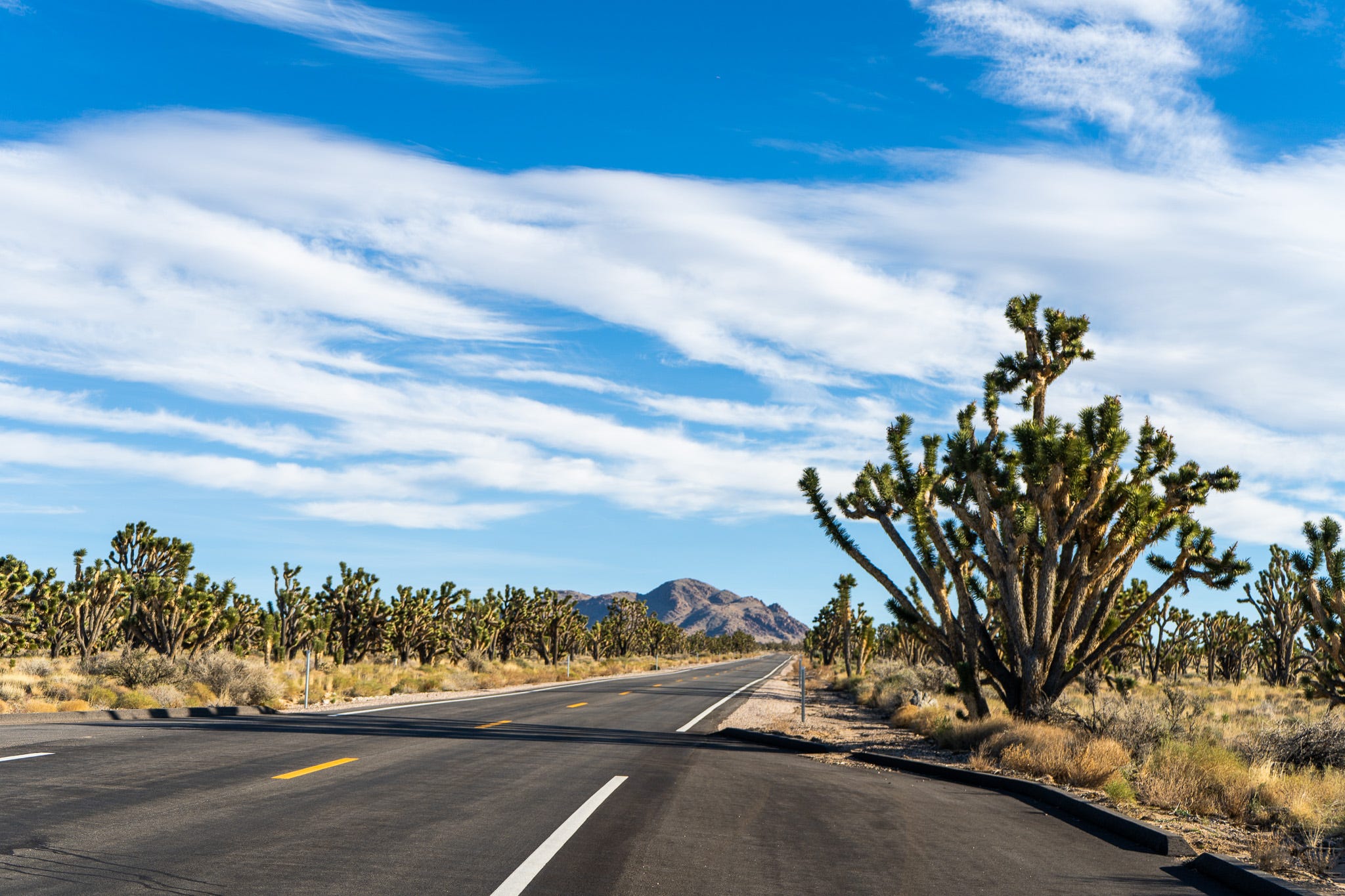
A real road’s road. It had the vacuumed hush of somewhere sacred. I could go 2 mph, stop in the middle of the road to take a picture, the car idling, my feet straddling the yellow-striped Looney Tunes road. I could go 100mph, but why? All I wanted was to drive and drive, into the horizon, like I was dreaming, both the main character and a speck of dust. When I finally decided to turn around and, to end the dream, a healthy, silver coyote darted across the road, from one side of the Joshua Tree forest to the other, and reminded me, no matter what it felt like, I had never been alone.
IX. Nevada
A. Seven Magic Mountains
When I was in college, one of the first assignments we were ever given — and one that’s stayed with me to this day — our professor showed us a slideshow of hundreds and hundreds of artists and their work. Historic, contemporary, every medium, blue chip, emergent, really the gamut. Then we were told to pick our least favorite and spend a week dissecting our disdain in order to write an essay on why.
My least favorite artist was Jessica Stockholder. I felt an immediate and potent dislike of her work. I was irritated by it. I think I initially wrote, “it’s just shapes, and colors, and her work arrogantly asks us to make meaning from that.” The more time I spent writing about my irritation and frustration the more it evolved and unfurled and transformed, too slippery to grasp; like one of those aquarium-gift-shop toys, a jelly-filled tube that shoots out of your hands the harder you squeeze.
Why was I opposed to shapes? Shapes and colors? What was so wrong with asking your audience to reduce their experience to such large nouns, such primary concepts? What more could you ask for, really, than something that moves you, whether to love or to hate, because they are so close. Which I think is exactly what my professor was trying to get us to realize.
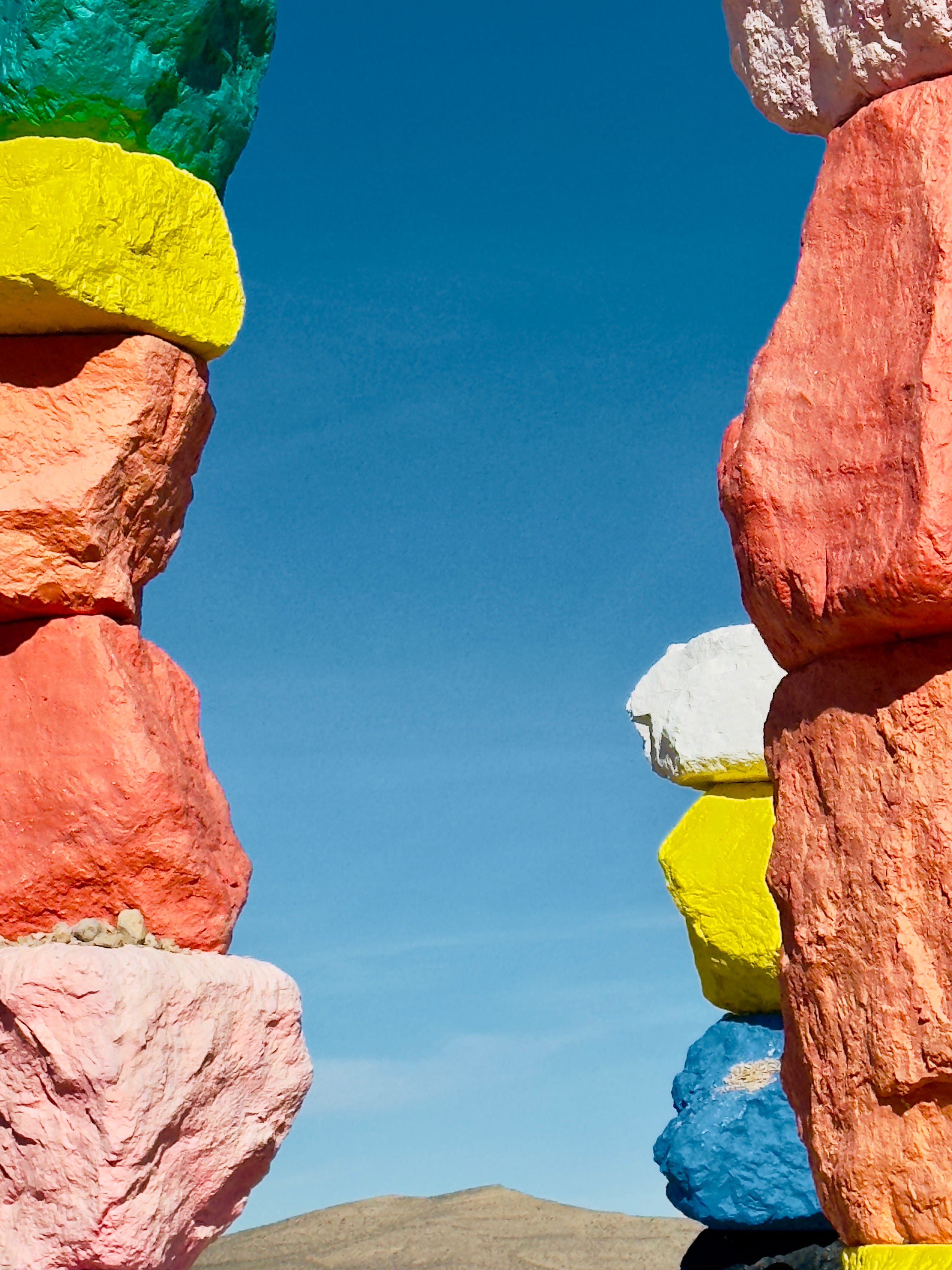
This is how I felt pulling up to Seven Magic Mountains. Initially, incredibly annoyed. This? The most populated site I’d been to yet? A full parking lot for seven stacks of rocks painted in road-safety colors, stacked like children’s blocks?
I read the panel slowly, in order to roll my eyes between words, and then went over to see… I guess, why not? I walked around the totems. I looked up. I watched people lean against them, take pictures in front of them, find shade in their shadow. The sun started to crest over one, rays blasting around it and my eyes shifted like a lens trying to focus, back and forth between the soft crumble of the mountains, the wild blue of the sky, and the toothaching brightness of these fluorescent rocks, like a toddler God had been caught playing in the Mojave and sent to bed.
I realized I liked it. And how important it is to hold your dislikes in the palm of your mind and turn them over and over, looking at them from all sides.
B. Red Rock Canyon
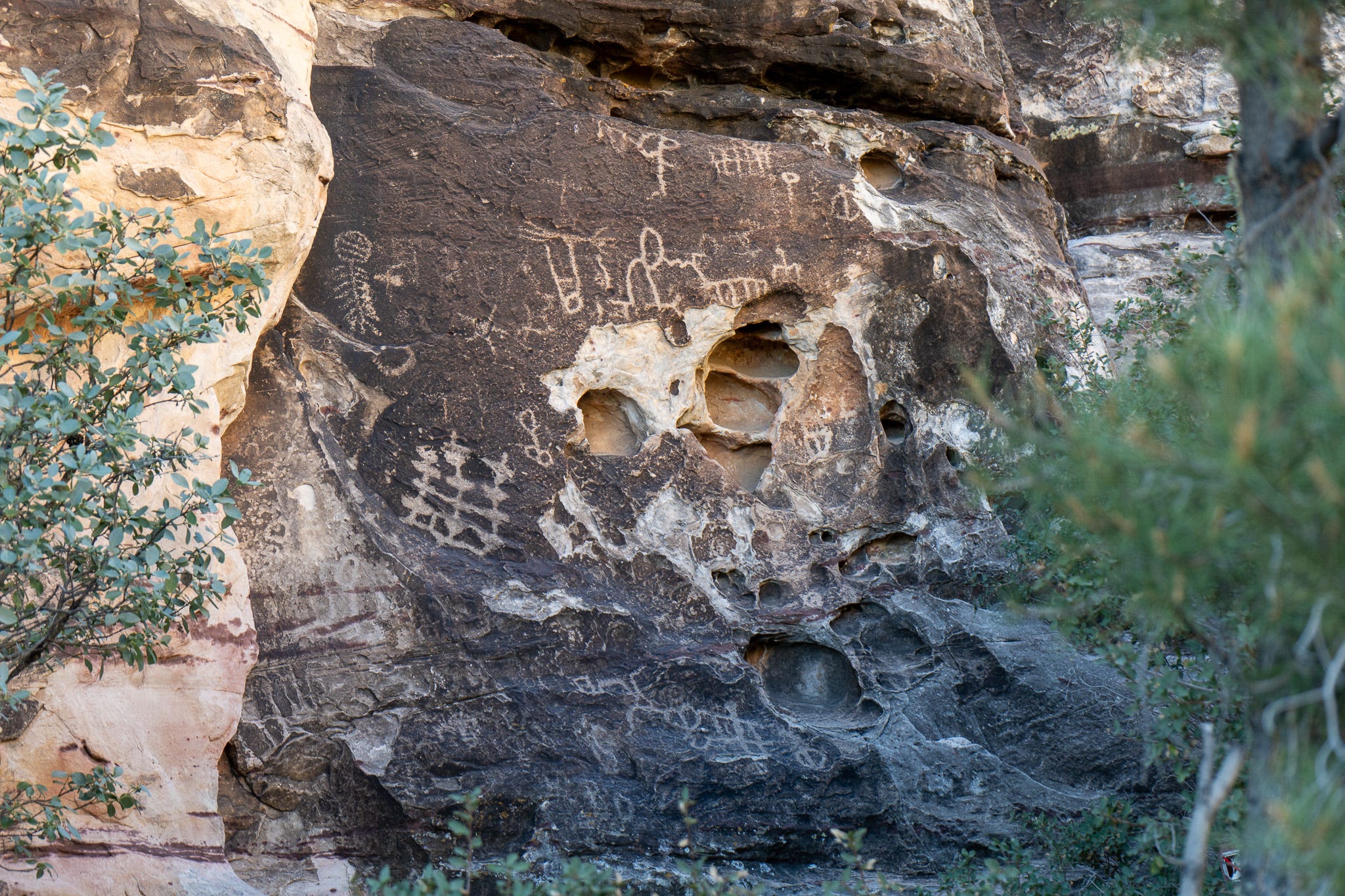
I hiked to the petroglyph wall, a modest walk from a parking lot within the park. Since it’s been organized for you, it feels accessible. But if you step back and really think about what that accessibility means against the backdrop of a landscape that sprawls across roughly 195,000 – 200,000 acres of desert, sandstone cliffs, and mountain ridges in the heart of the Mojave — acres and acres of flats, dunes, unscalable walls, and formidable cliffs, in the vastness of earth and time – we found these handprints, these intimate markings; serpentine, geometric, inscrutable. What were they? Are they bighorn sheep, did the hands that made this used to feed the wild horses? Is it magic? Is it art? Is it unbearably the same as now, everyone calling into the wind, I am here, I am here.
X. Vegas
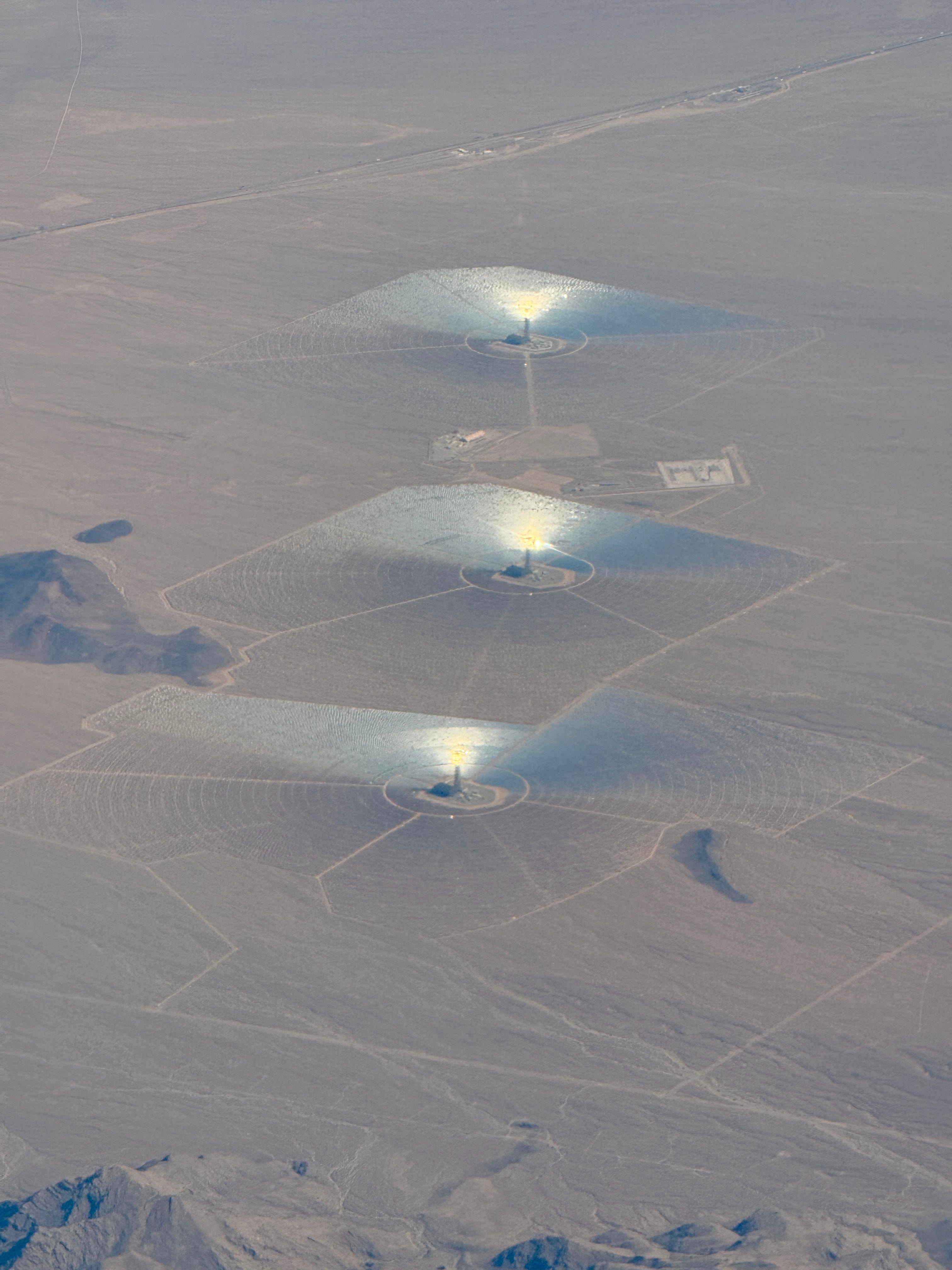
I have always loved arriving in Vegas. If you fly in you can see the distinct edges of this strange dream, it is a glittering postage stamp in the desert. (IF you fly in, be sure to look out the window for the Ivanpah Solar Electric Generating System, a digital cathedral, a the-call-is-coming-from-inside-the-house human crop circle) But for those who did the drive, Vegas is pure mirage, a glimmer, then a glitter. The joke after the sermon.
We want to believe in this total rearrangement of the natural order. For vast tracts of time and distance, we’ve had to look for something, we’ve had to search for shade, for water, landmarks, for company. For about 5 hours of interstate, we’re lizards. The lights in the distance are the city’s way of unburdening you, you don’t have to look anymore. In between Los Angeles and Las Vegas, two oases built entirely out of will, out of a shared conviction that we shouldn’t have to endure emptiness, that we should never feel nothing, not for any stretch of road, not in any direction. In magic, they call the final act the Prestige — the moment when what disappeared is returned, transformed, impossible. The lights of the Strip beckon, a little corny, not entirely convincing; but like in any trick, the audience is complicit, we want to be fooled.
You had me at Disney adult. Not proud of it but there doesn’t seem to be much I can do to rid myself of it. Wonderful piece Kendal. Your dad and his airplanes! Perfect.